Aviation Cadet William Looney

William Looney – an Air Force Aviation Cadet pilot.
Story by Ken Kula. Photography by William Looney via Scott Looney
People are drawn to the call of aviation by a myriad of impressions and opportunities. I’ve had the opportunity to look closely at one person’s progression from being a teenage spectator during World War II through to military pilot training during the mid-1950s, past the Korean War years. I’d like to tell a small part of his story as he became a U.S. Air Force Aviation Cadet, and trained to be a pilot.
William “Bill” Looney was a New Hampshire native who grew up in the city of Manchester. I work with his son Scott, and my coworker told me a few riveting tales his father told him about flight training and military service. One thing led to another, and I was soon looking at William Looney’s Pilot’s Logbook which detailed his primary flight training for the Air Force. I also read and viewed a collection of letters, important papers and some long-ago taken photos of airplanes; he was definitely interested in flying before his actual flight training. Born in 1930, Bill was too young to be called into the battles of the Second World War, but he took a number of black and white photos of airplanes and aviation events in southern New Hampshire around the months leading up to the conclusion of the War.

Republic P-47 Thunderbolt on the town green
One of his earliest photos that I could find had information on the back that read that this P-47 Thunderbolt was displayed on the Londonderry Town Green in 1944. Looking at this “Razorback” Thunderbolt, it was most likely a well-worn airframe, either a P-47C or early –D variant.

Douglas A-20 Havoc light bomber at Grenier Field
Another book of photos displayed a number of World War II Army Air Corp aircraft that were attached to a Liberty Bond drive in early 1945. According to a Manchester Leader newspaper article, these aircraft were open to the public on Manchester’s Grenier Field, an Army Air Corp base which is now the Manchester-Boston Regional Airport. Many Army aircraft types were represented, including a P-38 Lightning, C-54 transport, P-51 Mustang, TB-25 Mitchell bomber, AT-6 trainer and an A-20 Havoc. Of note here too, the newspaper’s article mentioned that a parachute jump and a new technology Coast Guard helicopter flying demonstration were part of the Open House at Grenier.

A trio of Chance Vought Corsairs at Manchester NH’s Grenier Field
Later on in 1945, a “Navy Day” was held at Grenier Field, and at least 11 F-4U Corsairs and an F6F Hellcat graced the ramps and allowed Bill to take more photos of airplanes. His photos showed an interesting feature, aircraft assembled contained the 4-bladed propellers of some of the later F-4U-4 version, while others were equipped with three bladed props of earlier F-4U-1 and FG-1 aircraft.
When he was able, Bill enlisted in military service. Just like the earlier generations of men in his family, he joined the Navy. His duties included being stationed on a destroyer, but nothing aviation-oriented at that point in time. During the late 1940s, he was part of the U. S. military machine that was cutting back the number of men and machines which would remain active in the defense of our county.
While he was in the Navy, the U. S. Air Force was created in 1947. The Aviation Cadet Program, which was the training pipeline for most Army/Air Force pilots and navigators, had begun during World War I and paused slightly during the late 1940s – due to the post-World War II cutbacks in men and material in the Armed Forces. Suddenly the Korean War and the sinister “Cold War” began and America suddenly needed pilots, navigators and all other aviation positions to be filled in growing numbers again.
The Aviation Cadet Program was reinstated in 1948 and soon plans were made to produce 3,000 USAF pilots per year, with additional navigators too. By the end of the Korean War in 1953, the need for more pilots in the USAF, while still a necessity, slowed down again. Still, a limited number of officers (almost all pilots and navigators were, and still are today, commissioned officers) were sent through the Program. The Aviation Cadet Program would continue to provide aviators up to the early stages of the Viet Nam War before other training initiatives (including ROTC) were implemented.
Bill Looney, who had moved from active Navy service to the U.S. Navy Reserve, was promoted to the rank of Seaman in late 1953. His life-long of aviation led him to apply to the USAF’s Aviation Cadet Program to become a pilot. He passed the requirements and testing of the time and was accepted in the Aviation Cadet Program’s Class 56-I.
The Aviation Cadet Program in the early 1950s was geared to screen potential pilots and navigators. Basic flying aptitude was required, and one third to one half of all enlistees did not complete this basic flight training. A rapid pilot training program and aptitude test was developed to thin the prospective pilot candidates’ ranks, after which (if successful) a student would go on to Officer’s School and more specific training, dependent upon what type of aircraft they’d be crewing. The flying portion of the Program was administered by civilian instructors at nine Air Force Bases.
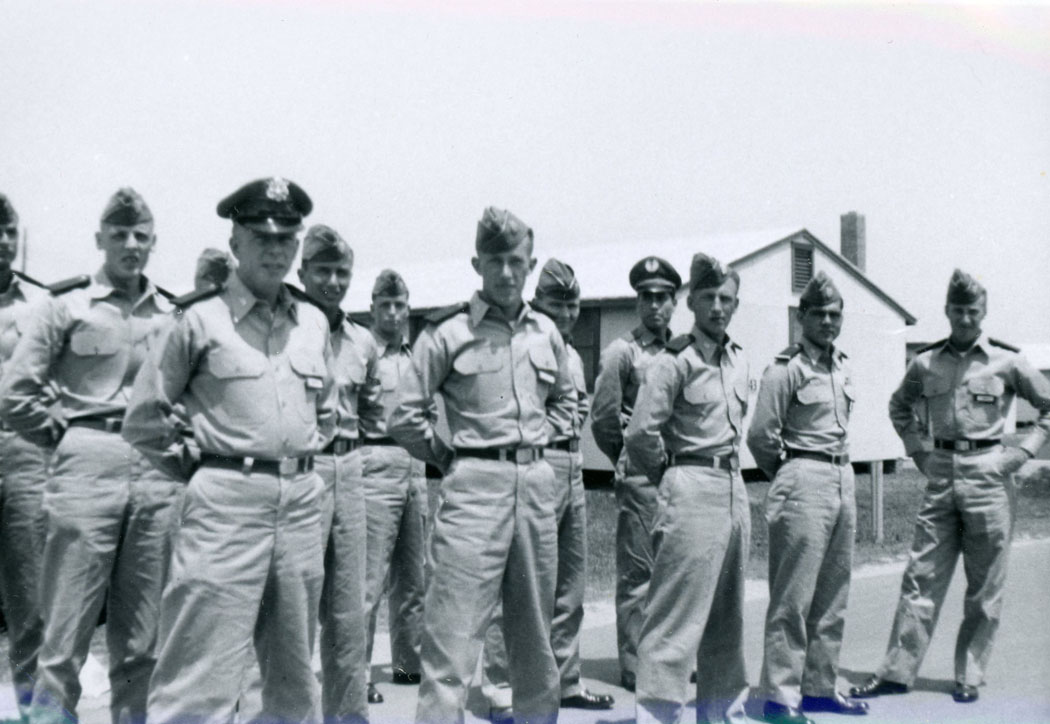
September 1954 Lackland AFB trainees… Bill is on the left
Bill attended basic training at Lackland AFB in 1954. In early 1955, he reported to Stallings Air Base, in Kinston, North Carolina for his Primary Flight Training. Academic studies were mixed with actual flight instruction over half of a year. Bill’s first flight instruction in an aircraft occurred on February 18, 1955 in a Piper PA-18-105 Special Super Cub. The Air Force supplied a number these aircraft, built between 1953 and 1956, to the civilian flight schools and its instructors. Although Air Force – procured, they carried civilian registration numbers. The two seats were in tandem, with the instructor in the rear seat most of the time.

William Looney aside a Piper PA-18 Super Cub. Two years later, the Pipers were replaced with Beech T-34 Mentors
Flights in the Super Cub rarely lasted over an hour, and often included multiple exercises and tasks to be completed while in the air. Most of Bill’s flights occurred “off base” to/from Simon Jackson Field, North Carolina. Others were operated from Stallings Air Base. The aircraft at nearby Jackson Field NC (the Cubs evidently flew from this satellite field) were all registered with three numbers followed by a “T” for their registration. Bill’s first flight as a Cadet on February 18th was in N234T, which he and an instructor flew from for a local forty minute introductory hop. Five days later, his second flight consisted of actual taking offs and landings as well as coordinated turns. Soon, Bill made his first solo flight in N180T on March 16, 1955, for a total of 45 minutes. The flight featured three landings. In all, Bill received 20 hours and 14 minutes of flying time in the Super Cub, including 3 hours and 13 minutes of solo time. He flew 27 sorties in the Cubs; several flights were made back to back on the same day. He logged time in 11 different Super Cubs during this stage of training; his last Cub flight was made on March 25, 1955.
Amazingly, in 2024 the majority of these Super Cubs still survive and are privately owned. Of the eleven Cub registrations in Bill’s log book, one was written off after a crash in 1982, several were sold to owners outside of the U.S., a few more airframes are retired, but at least five are still current and active today, including two in Alaska and Texas.
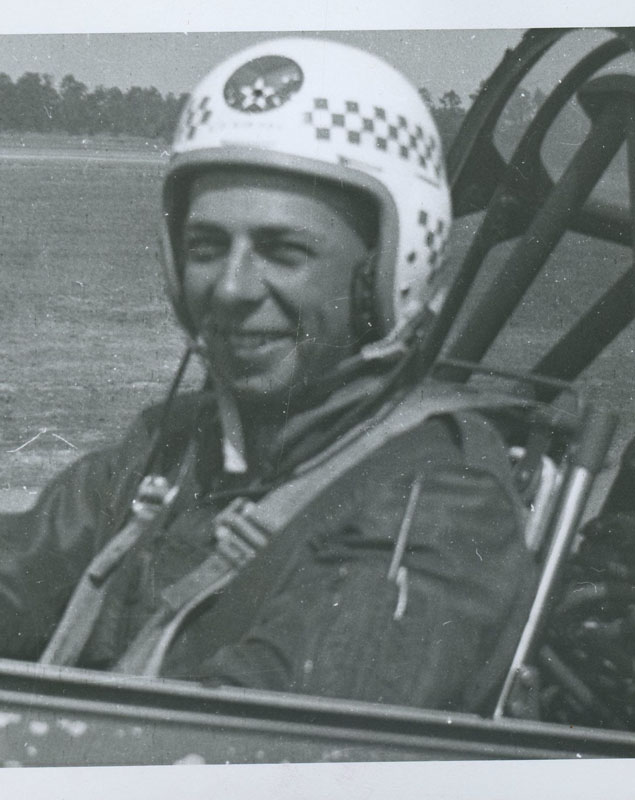
In a T-6G Texan cockpit all buckled in!
On March 30th, less than a week after his Super Cub finale, Bill moved into the cockpit of the North American T-6G Texan. His remark in his log book about his first Texan ride was “Two Dollar Ride – Area orientation”. He would now fly from Stallings Air Base, a larger airport than Jackson Field, with the much bigger T-6. Other airports in the vicinity of Stallings AB included Greenville NC, Wilson NC and Washington County NC. As with the Cubs, flight endurance was seldom longer than an hour.

Aviation Cadets received advanced training in the North American T-6G Texan in 1956. The following year these were swapped out for T-28 Trojan trainers
Bill didn’t get any solo time in the T-6G in this stage, it was all instruction on a higher performance aircraft. There were sessions within a pair of Link trainers too. Both the C-8 and the AN-T-18 simulators complimented the T-6 and offered some instrument flight training hours – up to 25 in total – for the prospective flight students. An interesting assignment of instructor pilots for T-6G training was that those instructors on the Piper Cubs flew with their students in the Texans too. Bill spent another 25 hours and 23 minutes in the Texan trainers, ending up with 43 hours and 21 minutes of instruction, and 3 hours and 13 minutes of solo pilot time. He completed his last logged training flight in the T-6 on May 11, 1955. Of note, the Air Force was interested in the number of landings he made (145 in total), in both the 105 horsepower Super Cubs and the 550 horsepower T-6G.

A matchbook cover from the Aviation Cadet Club at Stallings Air Base (now known as Kinston Regional Jetport)
Bill’s son Scott filled in some of “the rest of the story”. Sometime after Bill completed his initial flight training, he was involved in a flight accident, evidently at Stallings AFB. While flying as the Number 2 ship in a formation, a mix-up in the Control tower and a wind shift resulted in the assignment of a downwind landing runway to the pair of aircraft. Number 1 ended up stalling and crashing in front of Bill, who also ended up crashing. Surviving with a nasty gash to his forehead, he got assigned to base finance while convalescing.

Window decal from Sampson AFB, which was located on the edge of Lake Seneca, New York
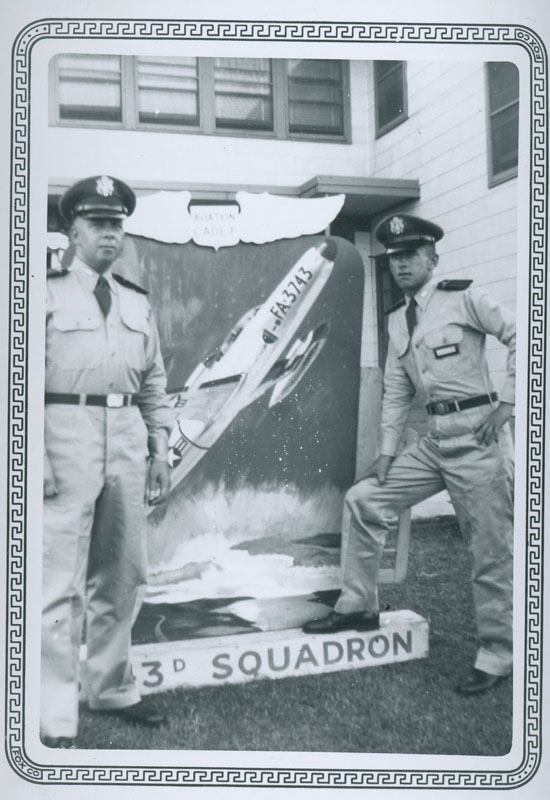
His accident caused him to stop flying for a period of time and his Class 56-I graduated without him. Bill was reassigned to the 3650th Basic Military Training Group (ATC) at Sampson AFB, New York in the state’s Finger Lakes region. His transfer paper, dated May 16, 1955, detailed his flight training thus far and stated “A/C Looney was recommended of OCS or further training inasmuch as he is qualified in accordance with USAF standards.”

Pilot training gear in 1956
During July, 1955, Bill was promoted in the Air Force to the rank of Airman Third Class. However, the unfortunate incident while at Stallings AFB ultimately led to the end of Bill’s Air Force flying days. A letter from an Air Force classmate named “Joe” was dated June, 1956, adds more background to this story. This letter was dated roughly a year after the time of his accident at Stallings AFB. It shines light onto a couple of obstacles to Bill’s airplane pilot aspirations. A freeze to Air Force promotions was mentioned. The closing of the Air Force operation at Sampson AFB was also noted. Bill had already decided to leave the military a year after his accident and go onto civilian flying and pursue a commercial airline pilot career. A prophetic sentence at the end of the letter read “Hope you get what you want with the Airline at home, but I think you will get into insurance sooner or later… I’m not usually wrong in my few predictions….there’s good money in it Bill.”
Bill did begin a civilian commercial flight training program in the early 1960s at Nashua New Hampshire, but never completed the course. Instead, just like Joe said, he went into the insurance field and was quite successful at it! Bill passed away a number of years ago, but he kept scrapbooks of his military training experiences which his son Scott and I were able to use to piece this story together.
So in the end, Bill’s interest in aviation got the better of him and he earned his pilot’s license. An interruption in training ultimately caused a career field change. If not for his accident, he might have gone on to a military flying career, but by being assigned to base finance after his injury, aviation did lend a hand to his ultimate occupation in the insurance industry.