Mid-Atlantic Air Museum World War II Weekend 5th Annual Night-Engine-Run Photo Shoot

Photos and story by Corey Beitler
The Mid-Atlantic Air Museum held its 34th annual World War II Weekend living history event and airshow on June 6, 7, and 8 at the Reading Regional Airport in Reading, Pennsylvania. World War II Weekend is the museum’s major fundraising event for the year and one of the largest World War II-themed airshows and living history events in the United States, capturing the essence of those important years in world history by transforming the museum grounds into a working wartime airfield. World War II Weekend includes a daily airshow featuring restored World War II aircraft, living history encampments and exhibits, a swing hangar dance on Friday and Saturday evenings, displays of restored military vehicles, and live entertainment with appropriate themes for the World War II era. World War II Weekend event draws over 30 restored aircraft, hundreds of restored military vehicles, and nearly 2,000 reenactors each year, with some coming from as far away as Canada to participate. Special guest speakers, including surviving World War II veterans, authors, and artists, also attend the event. World War II Weekend is a wonderful tribute to the “Greatest Generation”, honoring not only those who served in the armed forces during World War II but also those who worked on the home front to help the United States and its allies achieve victory.
This year, World War II Weekend welcomed some new aircraft to the event, including the Military Aviation Museum’s rare replica of a Messerschmitt Me-262, the type which became the world’s first operational jet fighter when it debuted with the German Luftwaffe in mid-1944. In addition to the Me-262, the Military Aviation Museum also brought its replica of a German Focke-Wulf Fw 190A fighter to the event. The Fw 190 was built in several fighter and fighter-bomber variants during World War II and was one of Germany’s best fighter designs of World War II. The Dakota Territory Air Museum also made an appearance at the event for the first time, with Warren Pietsch bringing the North American P-51C Mustang “Thunderbird”, an aircraft once owned by film actor Jimmy Stewart, to World War II Weekend. Returning to the event for the first time in several years was the B-29 Superfortress “Doc” operated by Doc’s Friends, and the Curtiss SB2C-5 Helldiver operated by the Commemorative Air Force’s West Texas Wing. Crowd favorites that once again attended the event included the Delaware Aviation Museum’s North American B-25 Mitchell “Panchito” and the Commemorative Air Force Airbase Georgia’s North American P-51D Mustang “Red Nose”.

For the fifth consecutive year, an exclusive “Night-Engine-Run Photo Shoot” was offered on Saturday evening as part of the Photo Experience package available to professional photographers at World War II Weekend. The Photo Experience package is available to 60 photographers at the event. The Photo Experience package at WWII Weekend includes the “Night-Engine-Run Photo Shoot” on Saturday evening, a sunset photo shoot on the airshow hot ramp, a sunrise photo shoot on the airshow ramp with living history reenactors, and access to a “Photo Pit” on the other side of the airshow grounds where light is better to photograph the afternoon airshow each day. The funds raised from the sale of the Photo Experience package are used by the Mid-Atlantic Air Museum to help cover their aircraft restoration efforts and the costs of hosting World War II Weekend and bringing aircraft to the event to fly in the airshow. The “Night-Engine-Run Photo Shoot” takes place under the guidance of World War II Weekend Media Coordinators Dave and Christina Brown. Lighting for this event is provided by Peter Lerro from Lerro Photography. Lerro Photography offers many special photography workshops throughout the United States each year featuring subjects such as aircraft, lighthouses, railroads, and living history events. For this year’s “Night-Engine-Run Photo Shoot”, the three aircraft selected to participate were the North American P-51C Mustang “Thunderbird” from the Dakota Territory Air Museum, the Cessna UC-78 Bobcat “Bamboo Betty” from Wings of War, and the Curtiss SB2C-5 Helldiver from the Commemorative Air Force’s West Texas Wing. Also supporting the event was Station 66 of the Muhlenberg Township Fire & Rescue, which was responsible for wetting down the ramp before each aircraft was run for light reflection.
Photographers who were participating in the “Night-Engine-Run Photo Shoot” gathered near the museum’s media entrance at around sunset, where they were met by Dave and Christina Brown and the other WWII Weekend Photo Escorts helping the two media coordinators throughout the weekend. Once everyone was gathered, the group was escorted to the north end of the airshow ramp, where the three participating aircraft were already staged for the event. Assisting with staging the aircraft and getting them fired up was handled by the Mid-Atlantic Air Museum’s flight line and tug team, which does an outstanding job throughout the weekend, moving and staging aircraft for ride flights and airshow demonstrations. As the starting time for the event drew nearer, Pete Lerro and his assistants set up the lighting equipment and explained the procedure for the shoot. Each aircraft would be run by itself for approximately 10 minutes for shooting. Lerro also gave some helpful suggestions to the gathered photographers on camera settings to use for the shutter, exposure, and ISO values. Although rain had fallen earlier in the day, delaying the airshow demonstrations and canceling some of the scheduled flying, conditions for the “Night-Engine-Run Photo Shoot” were clear, with seasonable temperatures and no rain.

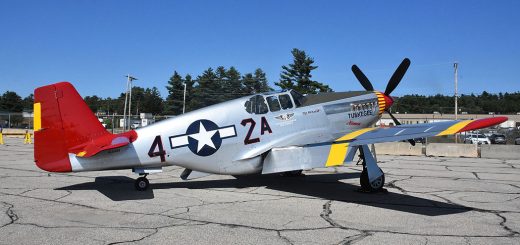
The first aircraft run was the North American P-51C Mustang “Thunderbird” from the Dakota Territory Air Museum. The P-51 Mustang needs no introduction to aviation enthusiasts, as it is one of the best piston-engine fighter aircraft ever built and one of the most famous fighter aircraft of World War II. The Mustang was designed to meet a Royal Air Force requirement for a long-range escort fighter. After swapping the Mustang’s original Allison engine with a Rolls-Royce Merlin engine, the Royal Air Force discovered the true potential of the Mustang’s performance at all altitudes. The P-51C variant of the Mustang was the first to use the Rolls-Royce Merlin engine, these engines being license-built by Packard in the United States. The definitive variant of the Mustang was the P-15D, which incorporated the Merlin engine, but also other improvements such as a bubble canopy for improved visibility and the addition of underwing pylons capable of carrying external fuel tanks, bombs, and rockets. Over 15,000 examples of the P-51 Mustang were built during World War II, and they served with Allied air forces, including the U.S. Army Air Forces, as escort fighters, and later in the war, as fighter-bombers. The Mustang’s performance was good enough that it also served as a specialized fighter-bomber during the Korean War, and surplus examples were used in postwar air races. The P-51C Mustang “Thunderbird” was owned by World War II Brigadier General and film actor Jimmy Stewart and later Jacqueline Cochran. “Thunderbird” won the 1949 Bendix Trophy Race, where it set a speed record of 470 miles per hour for a piston-driven aircraft. Warren Pietsch, Dakota Territory Air Museum, and other partners spent over 15 years restoring “Thunderbird” to airworthy condition.

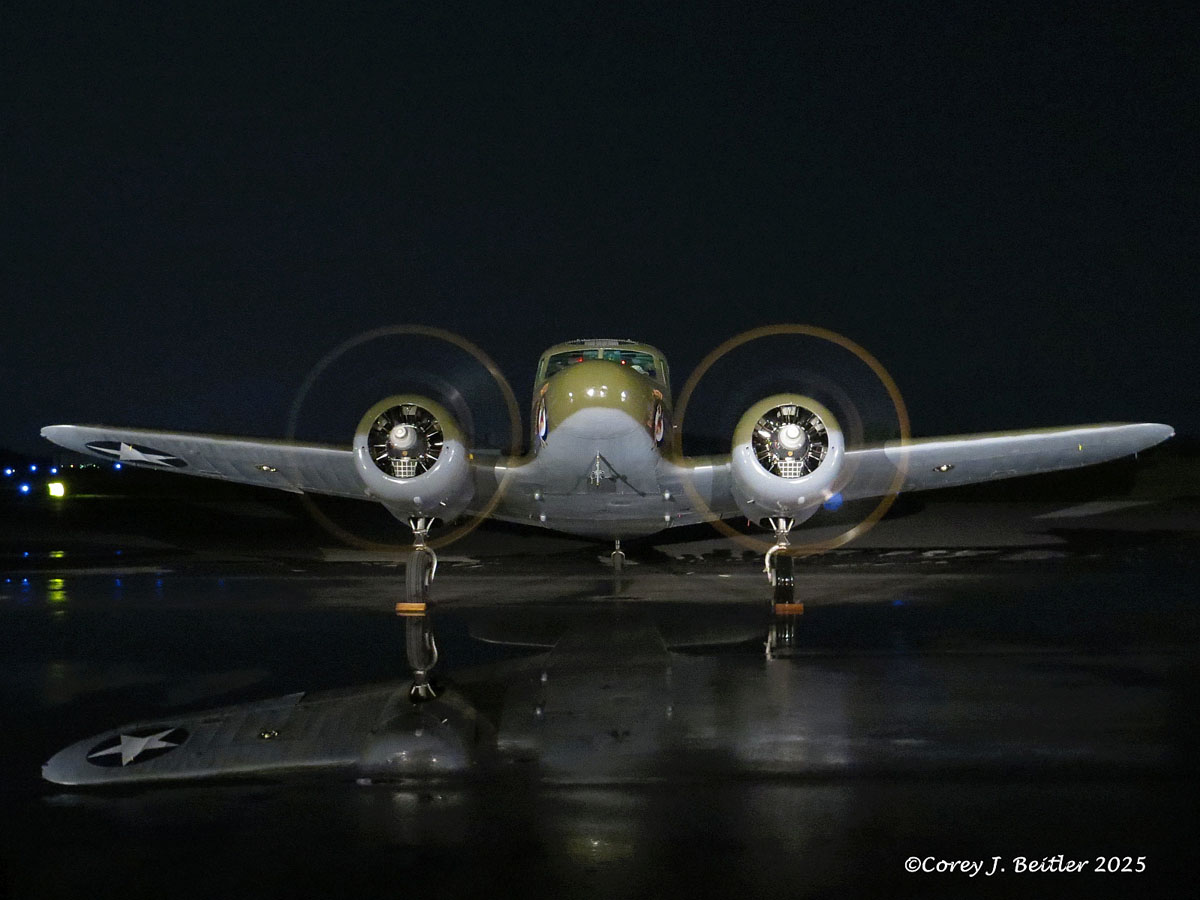
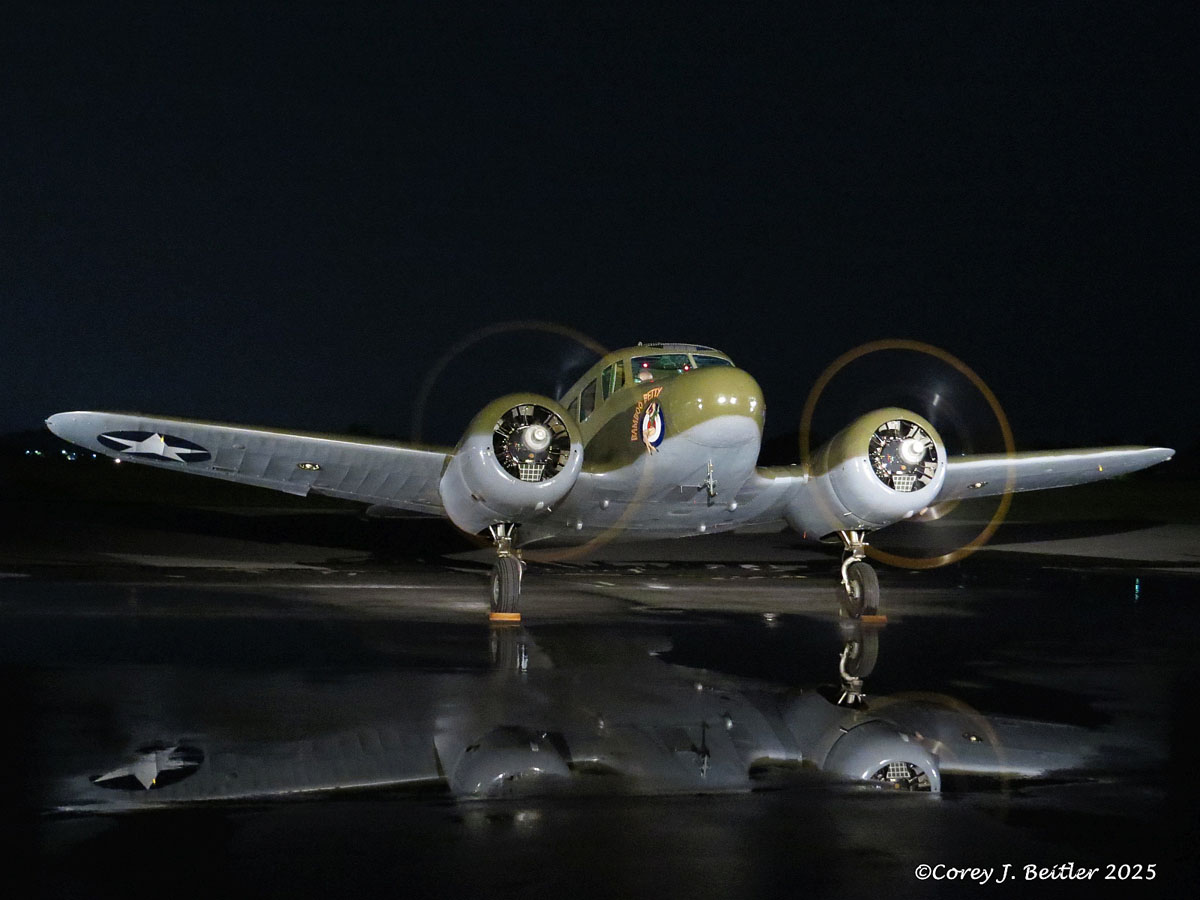
The second aircraft to complete an engine run during the “Night-Engine-Run Photo Shoot” was the Cessna UC-78 Bobcat “Bamboo Betty” operated by Wings of War. The UC-78 was one of the military versions of the Cessna T-50 civilian light transport aircraft. The T-50 was Cessna’s first twin-engine aircraft and the first Cessna aircraft to have retractable landing gear. The T-50 was primarily made of wood and designed as a lower-cost alternative to aircraft like the all-metal Beechcraft Model 18. Entering service in 1939. The civilian versions of the T-50 were operated by small airlines and air cargo companies. The T-50 saw service during World War II with the U.S. Army Air Forces in a training role, designated the AT-8 and AT-17. The Bobcat was also used by the U.S. Army Air Forces as a light transport and designated the C-78, later designated the UC-78. Design changes to the military variants of the Bobcat included additional cockpit windows and the installation of more powerful engines. Cessna produced over 4,800 Bobcats for the U.S. military for use as trainers and light transports during World War II. In military service, the Bobcats were known as “Bamboo Bombers” due to their wooden construction. The Bobcat was also used in large numbers by the Royal Canadian Air Force, where it was known as the Crane. The UC-78 operated by Wings of War was built as a Crane Mk.1 and delivered to the Royal Canadian Air Force in 1941. After being sold as surplus and operated by several owners, it became part of the Commemorative Air Force in 1979 and participated in airshows and aviation events for many years with the organization. Wings of War acquired the UC-78 in 2023 and completed a restoration on the aircraft. “Bamboo Betty” now attends local aviation events in Eastern and Central Pennsylvania, including World War II Weekend and fly-ins and special events at the Golden Age Air Museum in Bethel, Pennsylvania.
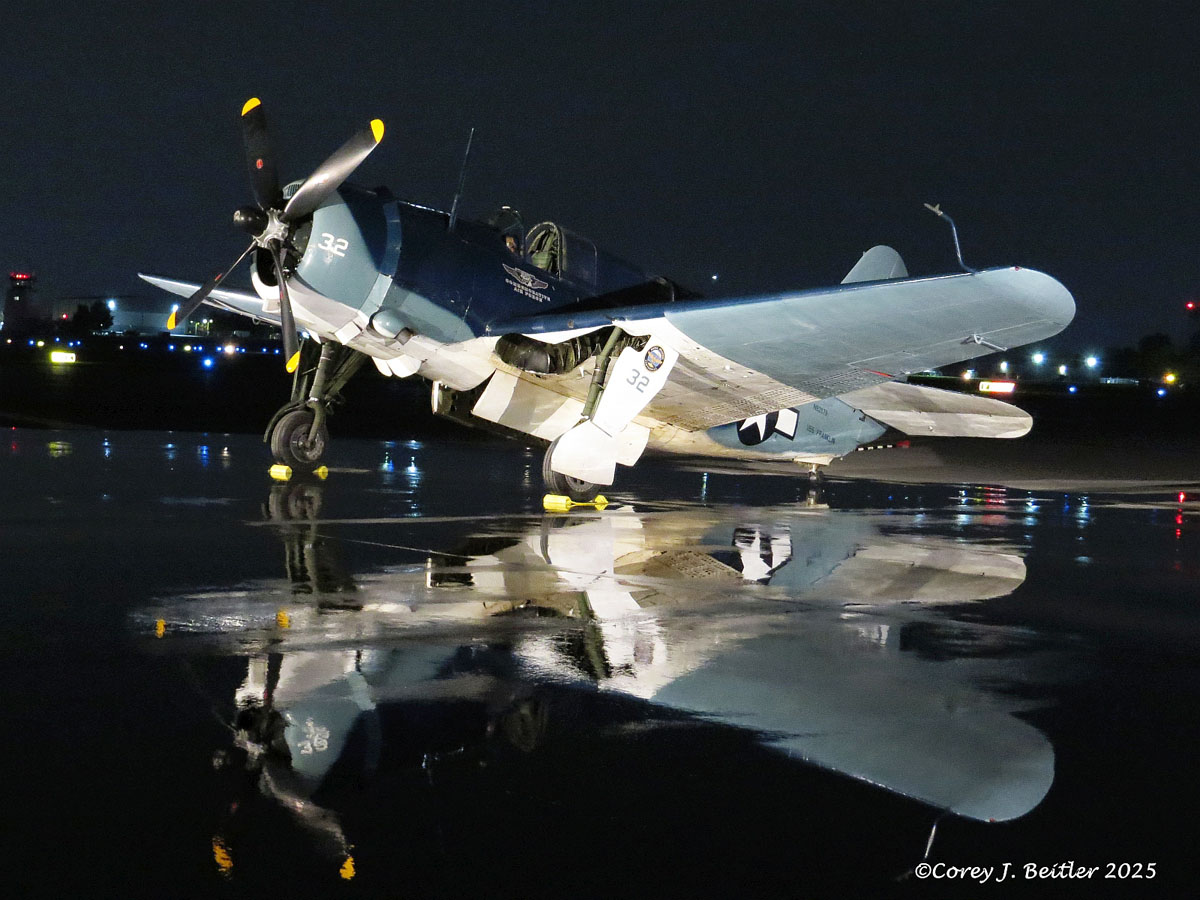
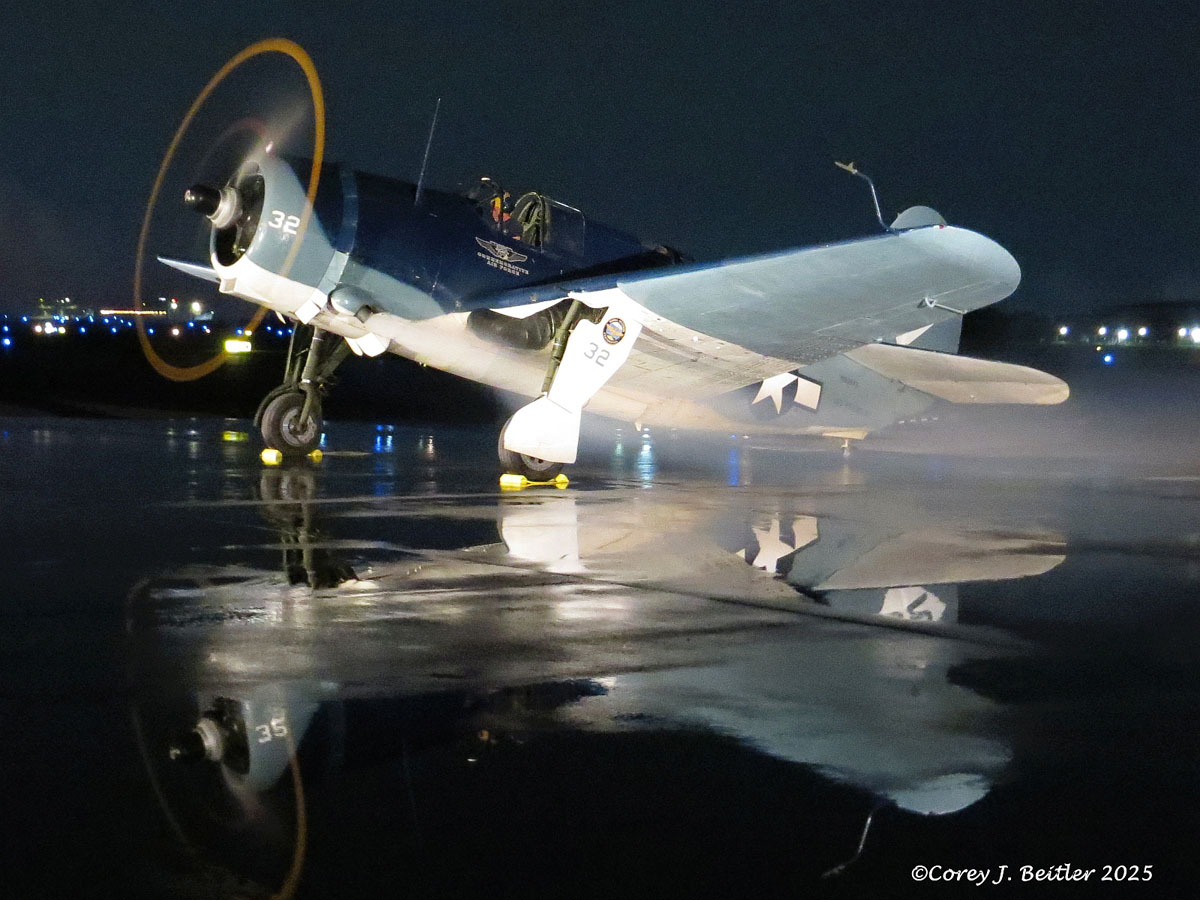
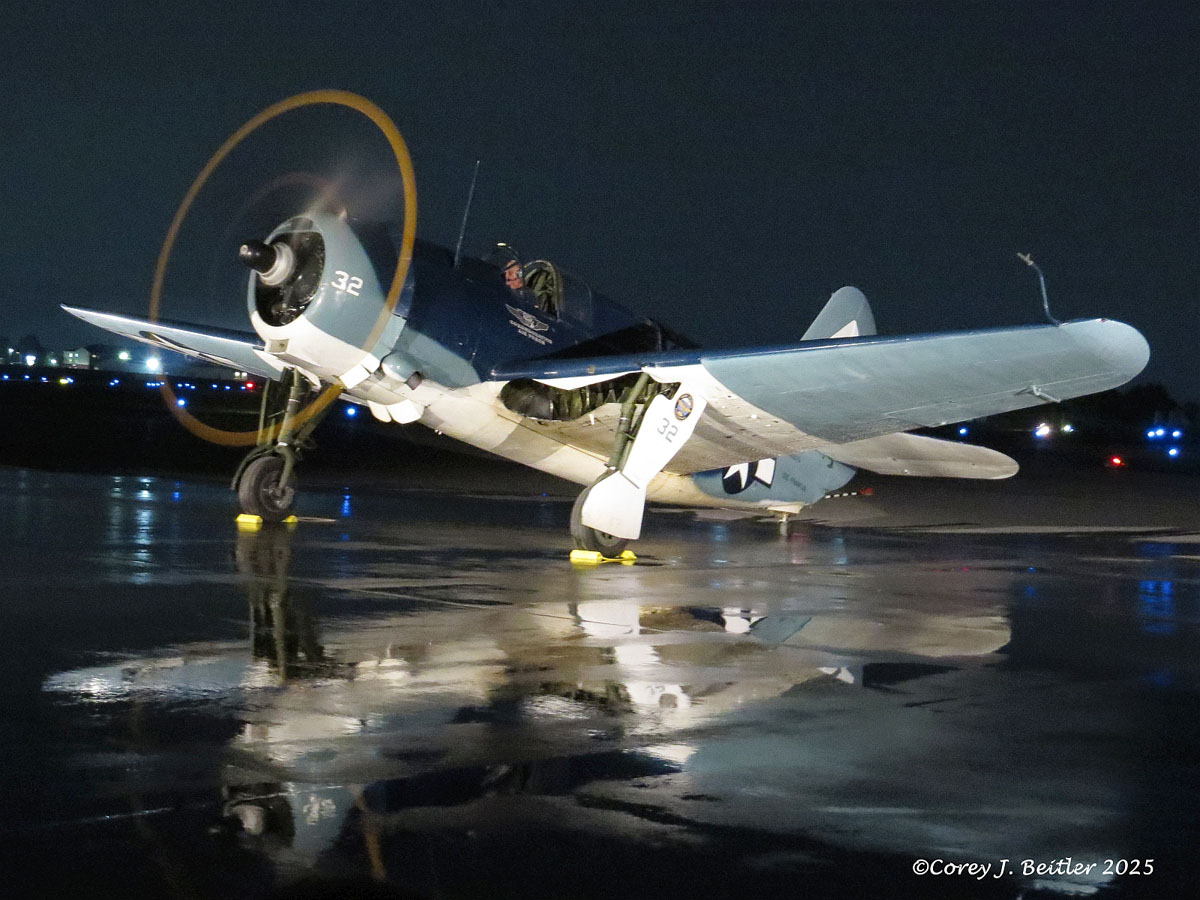
After the UC-78 completed its run, there was a brief delay as Station 66 of Muhlenberg Township Fire & Rescue went to get more water with their fire truck to wet down the ramp a final time for the last aircraft to run, the Curtiss SB2C-5 Helldiver from the Commemorative Air Force West Texas Wing. There was an additional delay as Ed Vesely had some trouble keeping the Helldiver running on the first startup due to a cold engine. Vesely had to shut the engine down, check some systems, and restart the aircraft. On the second attempt, the Helldiver’s engine smoothed out with no issues, and the engine run would be completed as normal. During the engine run of the Helldiver, the aircraft’s wings were folded and unfolded twice, giving photographers a rare opportunity to capture the motion of the wing movement with a long exposure photo.
The Helldiver was a dive bomber developed by Curtiss-Wright during World War II. Designed to replace the venerable Douglas SBD Dauntless, the Helldiver served primarily with the U.S. Navy in the Pacific theater of operations. The Helldiver was the last purpose-built dive bomber ordered by the U.S. Navy, and the aircraft had numerous difficulties that delayed its entry into service. Poor handling characteristics, propeller problems, and a complicated electrical system led to multiple and significant design changes to the aircraft. Stability problems were caused by the aircraft’s short fuselage, which was mandated so it could fit on aircraft carrier deck elevators. Early examples of the Helldiver entered operational service in late 1942, but the teething problems meant they saw limited combat. The Helldiver’s tricky handling characteristics and chronic maintenance problems led to pilots and aircraft carrier flight deck crews referring to the aircraft as “The Beast”, and even less affectionately as “Son of a Bitch, 2nd class”, derived from the aircraft’s SB2C designation. A chronic lack of power was solved when the SB2C-3 variant was introduced in 1944, which used a 1,900-horsepower R-2600-20 Twin Cyclone radial engine and a four-blade propeller. Despite the problems, the Helldiver participated successfully in battles over the Mariana Islands, Philippines, Taiwan, Iwo Jima, and Okinawa. The Helldiver also played a critical role in the sinking of Japanese battleships Musashi and Yamato. After World War II, the Helldiver was quickly phased out of service with the U.S. Navy, but small numbers of the aircraft remained in service with the navies of France, Portugal, Greece, and Thailand. The Commemorative Air Force’s West Texas Wing Helldiver is a late-production SB2C-5 variant, and for many years, was the world’s only flying example of the Helldiver. The Helldiver has been grounded for the last few years due to engine problems and is airworthy again after having its engine rebuilt, allowing it to once again visit airshows and aviation events throughout the United States. As a finale to the “Night-Engine-Run Photo Shoot” a restored Jeep painted as a World War II U.S. Navy “Follow Me” airfield vehicle was positioned next to the Helldiver for some static night photos.

The 5th Annual Mid-Atlantic Air Museum World War II Weekend “Night-Engine-Run Photo Shoot” was a huge success. Despite the largest number of photographers ever signed up for the event, the process went smoothly, and all of the photographers were courteous to each other, so everyone had the opportunity to get the photos and videos they wanted of each aircraft. Special thanks go to the Mid-Atlantic Air Museum, World War II Weekend Media Coordinators Dave and Christina Brown, the WWII Weekend Photo Escorts, and the Mid-Atlantic Air Museum WWII Weekend Flight Line Crew for their efficient running of this event. Thanks also go out to Peter Lerro from Lerro Photography and his volunteer staff for providing the lighting and giving up their evening so the shoot could take place. Station 66 of Muhlenberg Township Fire & Rescue also did an excellent job providing wetting down the ramp so each aircraft had plenty of reflection during the photo shoot. Finally, thanks go to the Dakota Territory Air Museum and Warren Pietsch for providing the P-51C “Thunderbird”, Wings of War, and pilots Tom Beamer and Eric Ridilla for providing the UC-78 “Bamboo Betty”, and the Commemorative Air Force West Texas Wing and pilot Ed Vesely for providing the SB2C-5 Helldiver for participation in the “Night-Engine-Run Photo Shoot” and helping make the event a success.