An Interview with Britt Lincoln

July 23, 2026
by Del Laughery
Since the advent of powered flight in 1903, pilots have been admired for their brave and daring deeds. In the very early days of aviation the role of pilot was limited to a very few, self-taught, non-licensed individuals who flew to fulfill the early demand for military reconnaissance, airmail delivery, commercial travel, and exhibitions meant to thrill the general public and build interest in this new mode of travel. In fact, despite the fact that commercial airline travel started in 1914, it wasn’t until 1927 that the first U.S. pilot’s license was issued by the federal government under the new Air Commerce Act of 1926, which instituted certain regulations over civil pilots and their aircraft.
Early aviation was very much a male-centric endeavor. Women of the time were expected to raise children, manage their households, and provide moral guidance for the family. Culturally, women in the workforce were not looked upon in a positive light by their male counterparts being more tolerated than welcomed. Women had to overcome significant social hurdles to enter most occupations, none more so than those within the new realm of aviation where men were men – you know, devil-may-care guys doing what we do – and women were second-tier observers. That said, even in the early 1900s a broad social shift away from those gender-based norms was in its early stages and notable female pilots found their way into the skies.
Within the United States, Harriet Quimby moved from her professional role as a journalist to become the nation’s first female pilot in 1911, while Katherine Stinson, the fourth licensed woman pilot in the U.S. thrilled audiences performing hazardous maneuvers as early as 1915 in her travelling stunt flight road show. Six years later, Bessie Coleman overcame not only gender-based societal barriers, but also racial hurdles to become the first licensed Black and Native American pilot in 1921. Soon after, Elinor Smith, known as the “Flying Flapper of Freeport” set endurance, speed, and altitude records as a teenager in the late 1920s; while at the same time the Ninety-Nines, an organization founded by 99 female pilots led by Amelia Earhart, was founded to provide professional support for women in aviation.
Between 1939 and 1941, regional conflicts in Europe and Asia exploded resulting in the global struggle known as World War II. As terrible as the conflict was, ending in August 1945, it acted as a massive catalyst that permanently shattered gender-based stereotypes within aviation. While I could discuss notable women pilots within the various facets of aviation since that time, it’s here that the discussion narrows down to the world of competitive aerobatics. By 1948 Betty Skelton won three consecutive International Female Aerobatic Championships in “Little Stinker,” her Pitts S-1C. In the early 1970s, Mary Gaffaney became the first U.S National Aerobatic Champion. By the early 1990s, Patty Wagstaff won the combined men’s and women’s U.S. National Aerobatic Championship consecutively for three years – flying competitively or on the air show circuit until 2025. While there are a number of standouts within the current generation’s female aerobatic pilots, I had the opportunity, and distinct pleasure, to interview athlete, and competitive flyer Britt Lincoln as she rested between flights at 2026’s EAA Air Venture in Oshkosh, WI. She’s a fourth-generation pilot who entered the competitive stage in 2019. Lincoln refers to herself as a “Vitamin G addict,” is a member of the U.S. Unlimited Aerobatic Team, and her name rightfully appears on the same marquee as the remarkable flyers mentioned earlier.

PHOTORECON: “We’re here at the Experimental Aircraft Association’s Jack Mark Hanger on the very north side of Wittman Airport, in Oshkosh, talking to, Britt Lincoln. Firstly, do you prefer your full first name or the shortened version?”
LINCOLN: “Well, I think at this point, most people in the industry know me as Britt and my full name is Brittanee, but it’s spelled oddly and it’s long.”
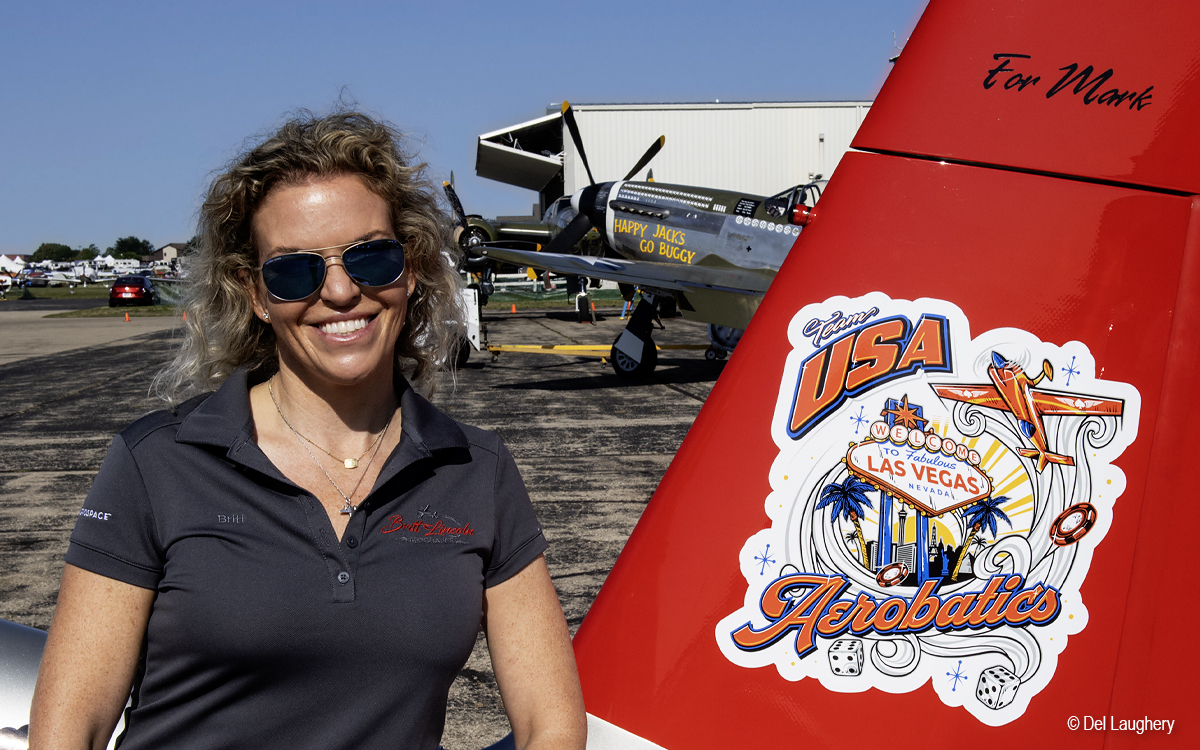
PHOTORECON: “Fair enough. So, I’d like to start off in sort of an odd place. This morning when I had an opportunity to look at your aircraft I saw on its tail, at the very, very top, it says For Mark.”
LINCOLN: “Ah, yes.”
PHOTORECON: “Can you tell me about Mark?”
LINCOLN: “Yeah, that was actually a friend of my partner, his best friend, who passed away in an airplane accident seven years ago. He actually also used to fly that airplane. He was active in the competition world.”
PHOTORECON: “So, this is your tribute to him.”
LINCOLN: “Yes.”

PHOTORECON: “Let’s get into your story. What is the origin and the path you followed of this thing that could almost be referred to as a calling? I guess that’s as good a word as any. I think aviation, particularly those who work in it, is a calling. I don’t think you do this for much more than the love of seeing wings on either side of your plexiglass windscreen. Tell me about that. What are the bridges that got you here?”
LINCOLN: “It kind of chose me. I didn’t really choose it. It starts from long before I was even in this world. I’m a fourth-generation pilot. Both my great-grandfather and my grandfather were crop dusters in northern Montana. The first time I was in an airplane, I was six days old with my grandfather.”
PHOTORECON: “I have this image of you in a swaddling blanket, with him holding onto you with one hand and the stick with the other.”
LINCOLN: “Yeah, so he actually had one of those baby carriers, and he put me in the baby carrier and put it in between the two yokes of his Cessna 180. He said the baby carrier just fit perfectly between the two yokes. I was in the seat for takeoff, and then he just set me up on the yolks and just took me around flying.”
PHOTORECON: “And he was crop dusting in a 180?”
LINCOLN: “No. This was a different airplane. This was the family aircraft.”
PHOTORECON: “All right, so great grandpa and grandpa are crop dusters. What about dad or mom?”
LINCOLN: “Dad got his private pilot’s license but was not a crop duster. I actually grew up with my grandparents. They raised me, so I was around it my whole life. We had a grass strip right in front of our house out on the farm. That’s where my grandpa taught me to fly in our Piper Super Cub.”
PHOTORECON: “And I imagine as you progressed through this profession of yours, Grandpa’s head got larger and larger and larger just swelling with pride.”
LINCOLN: “Well, you know, it’s funny, it actually didn’t come until later. Like many kids and teenagers who grow up with something, you know, I always loved it, and I enjoyed it, and it’s something that I did with my grandfather. We were very, very close. And I sort of took it for granted. I was busy with other things in high school. You know, sports, and speech, and debate, music and a lot of other things. So, I didn’t get my license. I went off to college, and studied; and then after college, I moved to Europe, which, of course, is not very GA [General Aviation] friendly. I was in Europe for about six years. I repatriated in 2010 and was living and working in the Bay Area in California and was there for several years. And actually, what prompted me to finally get my license was being able to fly with my grandfather. I would go home, and I would fly with my grandfather and it was something that was just really special to us. And I started to realize that he was aging; and that if I didn’t have a license, there would be a point where he wouldn’t be able to fly, and it wouldn’t be something that we’d be able to share. So, that was sort of my motivation to finally get a PPL [private pilot’s license]. He was not a CFI [certified flight instructor]. So, I did my PPL at a flight school in the Bay Area. It was actually the first time I’d ever flown an airplane with a nosewheel, because everything else I’d flown was a tail dragger. That’s what I learned in.”
PHOTORECON: “Were you under all that Bay Area controlled airspace?”
LINCOLN: “Yeah.”
PHOTORECON: “So, you’re dealing with that as a new pilot. That’s a heavy load right there.”
LINCOLN: “It was good. It was good training. It added another layer of skill. Out on the farm in Montana we didn’t even talk on the radio. There was nothing around.”
PHOTORECON: “Who was there to talk to?”
LINCOLN: “Exactly. So, my plan was really just to get my PPL to just be able to fly with my grandfather. I was in finance. That’s what I was doing. I was working in the finance world, and…”

PHOTORECON: “Here are the bridges I was talking about. How do you go from a finance person to being an aerobatic pilot?”
LINCOLN: “Exactly. It was just serendipitous timing how all of this worked out. I had just gotten my PPL and the company that I was working for went through some mergers and some changes, and they’d actually asked me at that point to move to Manhattan. And we did some negotiations, and I decided ultimately that wasn’t the right fit for me. So, we parted ways; I took a severance; and I just decided that I was going take a little bit of time for myself. I was really enjoying the flying, but I’m super goal-oriented, and I wanted something to be working on, and working towards rather than just going up and boring holes in the sky. There were other people at my flight school who were working om their instrument rating and I thought, well, I’ll do it too. It’s a reason to fly but also something to be working towards. So, I started working towards my instrument and then once I had that, I thought a commercial check ride isn’t much more difficult than a PPL check ride. So, I actually then went back and spent the summer in Montana flying the Super Cub in the mountains with my grandpa and building time to get my 250 hours for my commercial. I actually took my commercial check ride in the Super Cub, in the airplane that I learned to fly in.”
PHOTORECON: “That’s very cool.”
LINCOLN: “Yeah. And then, of course, multi-engine seemed like a natural next step and it was simply an add-on to what I had already accomplished. Then, while I was in Montana that summer, I had the opportunity to get my seaplane rating. So, I did that as well. I did five ratings in about 13 months.”
PHOTORECON: “Back to you being goal-oriented, right?”
LINCOLN: “Yes, exactly. I obviously just really had the bug. The aviation bug. It bit me. And then I went back to California, and I was definitely an airport bum. I was hanging out at the airport in Livermore, California; I didn’t know anything about aerobatics or competition. I didn’t even know about aerobatic airplanes. One day I was driving down a hangar row at the airport, and there was a hangar that was open, and it had these beautiful red airplanes in it. And I stopped, and I just walked in.”
PHOTORECON: “Because you can! Aviation people are so friendly.”
LINCOLN: “Because I can. I walked in, and there was a man in there, and I said, ‘Hey, can I look at your airplanes?’ And it was a Pitt S-2B and a Super Decathlon, and he said, ‘Yeah, sure, come in and look.’ He showed me the airplanes and started talking about competition and aerobatics, and, I mean, it was like he was speaking Greek. I had no idea what he was talking about. After he talked to me about aerobatics and competition for about an hour he said, ‘Well, I was going to take the Pitts up for a flight. Do you want to go?’ And I said, ‘Sure.’ So, we went up. And he started with some gentle barrel rolls, and then a competition roll, and a loop. And let me do a couple, and I kept saying, ‘Well, what else can you do?’ He’d been doing competition for over 20 years and had taught a lot of people about the sport and brought a lot of people into competition. We were flying and I kept saying, ‘What else can we do?’ And he kept saying, ‘Are you sure? You know; are you okay?’ And I kept saying, ‘Yeah, let’s do something cooler.’ By the end, we were doing Lomcováks and pushes. And finally, he said to me, ‘We’re gonna have to go back. I’m gonna run out of gas.’ After we landed, he said, ‘You need to learn how to do this. In 20 years, I haven’t taken one person for a ride for the first time that could do any of that stuff.’”
PHOTORECON: “So, you have an almost genetic predisposition for this role.”
LINCOLN: “Yeah, you know, I have to think that starting riding in airplanes at six days old, maybe had something to do with it. So shortly after that, I started training with him. I learned in a Super Decathlon with him — a 220-pound ballast in the back seat. About four weeks later, I entered my first competition. I just thought this will be something fun – It would be a really cool experience. Just improve my skills a little bit more. That was in 2019.”
PHOTORECON: “Okay, so we’re seven years ago now?”
LINCOLN: “Yep, 2019, I flew my first contest in Primary.”
PHOTORECON: “I was about to ask. I don’t know anything, honestly, about the aerobic circuit at all. I presume there’s different levels of competition.”
LINCOLN: “Yeah. There are five levels. And, that’s basically of how it started for me. And it just pretty quickly became a big part of my life, and, I love it. And it turns out I’m pretty good at it.”
PHOTORECON: “Pretty good at it. If we count all the days you’ve flown here at Oshkosh, plus Duluth, I’ve seen you three or four times in the last two-ish weeks. And you’re a pleasure to watch to fly.”
LINCOLN: “Thank you.”

PHOTORECON: “Just extraordinary the amount of control you maintain over that aircraft.”
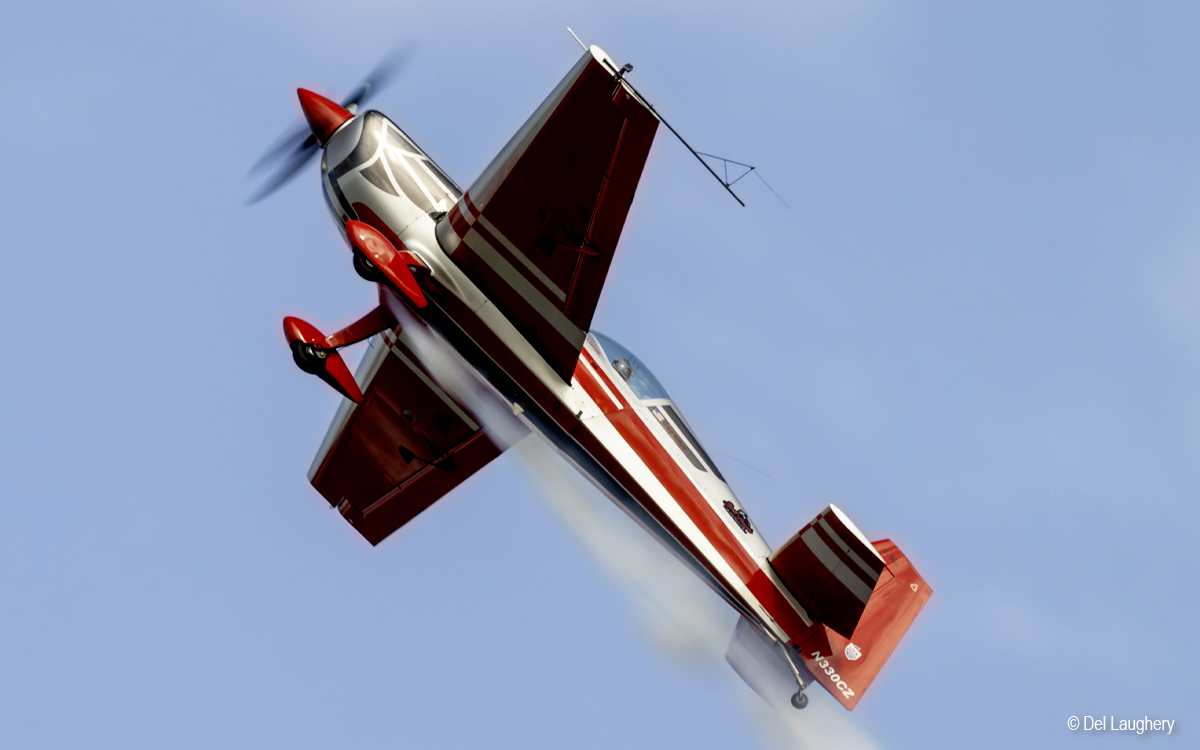
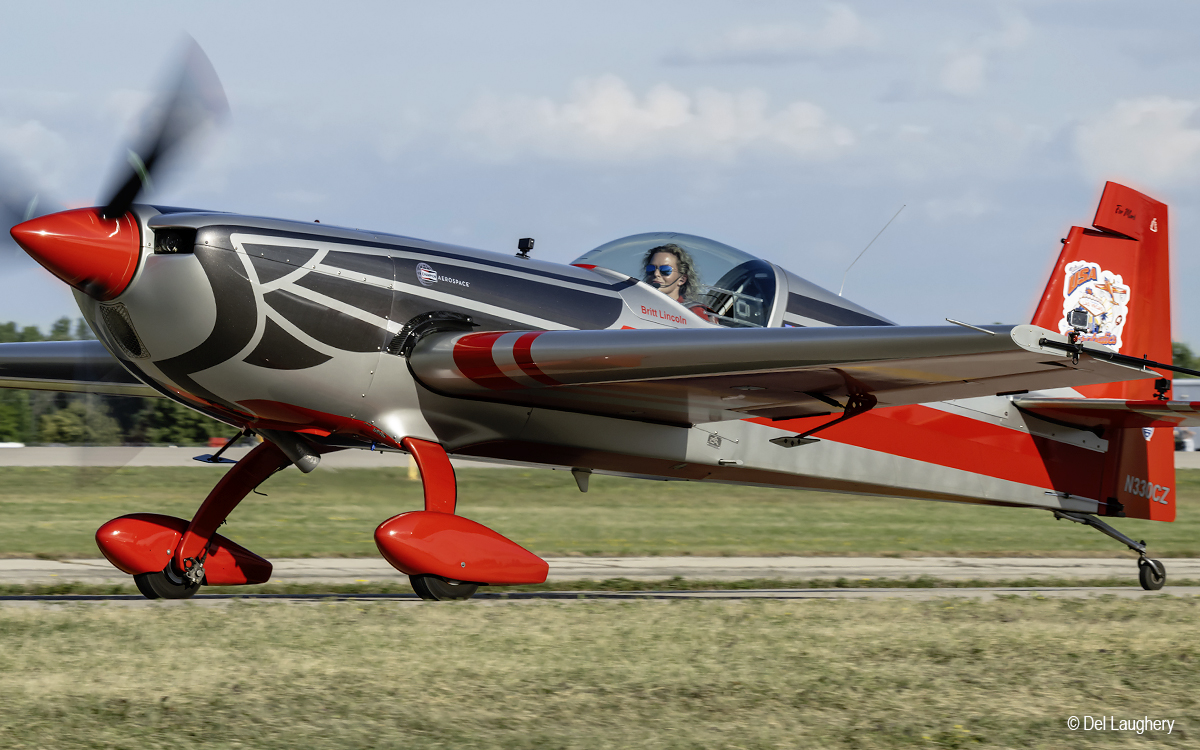
LINCOLN: “Thank you. And so, obviously, I didn’t start flying air shows right away. I really gained a lot of experience and worked up through various aircraft. You know, right now, I’m flying the Formula One of aerobatic airplanes. But that’s not where I started. I started in a Ford Focus. It’s the same as when you’re learning to drive, you don’t hop into Ferrari right away. So, I’ve worked a lot and I’ve practiced a lot and got a lot of coaching and started flying air shows in 2023.”
PHOTORECON: “Are air shows an invitation-only kind of thing or do you have to kind of knock on the glass?”
LINCOLN: “No, there’s a process. There is a formal process. The International Council of Air Shows, ICAS, oversees and governs that and works together with the FAA. The FAA gives them some authority, and there’s an evaluation process, kind of similar to a check ride. Airshow pilots are evaluated by an ACE (Aerobatic Competency Evaluator); these are the equivalent to a DPE. There is an oral ground portion and a flight evaluation, which they observe from the ground. The ACE needs to make sure that they’re comfortable with your knowledge and your understanding and that you fly a safe sequence. There are some very specific rules in flying airshows that we need to abide by. Every airshow pilot needs to be evaluated by an ACE each year.”
PHOTORECON: “Do you maintain some kind of a person, or mentor, that looks out for the almost inevitable bad habits that will develop over a career?”
LINCOLN: “Yeah, you know, aviation is already a small community, and then you start getting into aerobatics and air shows and it gets even smaller. We really have a great community. I have several people that have taken me under their wing and mentored me and helped me and given me lots of great advice.”
PHOTORECON: “I imagine no one can do this alone.”
LINCOLN: “No, definitely not.”
(At this point, Mr. Jeff Boerboon, team captain of the International Aerobatic Club’s U.S. Unlimited Team, enters the room. After some quick introductions, and equally quick conversation between Britt and Jeff, Jeff departed and the interview continued.)
LINCOLN: “He’s one of them.”
PHOTORECON: “So he keeps you on the straight and narrow.”
LINCOLN: “Yep. Yep. Him, Mike Goulian, and Craig Gifford have been some wonderful mentors.”
PHOTORECON: “You’re turning in the circles of the big names in this business.”
LINCOLN: “For sure. Yeah.”
PHOTORECON: “Was there a point where you realized you’ve sort of arrived? I’m back to that whole goal-oriented thing. You’re right there at the at the top of the profession’s triangle. What’s next for an aspirational person like you?”
LINCOLN: “I don’t know. I’m still, sort of, pinching myself. I mean, being here and flying at Oshkosh.”
PHOTORECON: “Is this your first time at Oshkosh?”
LINCOLN: “I flew last year as part of an IAC competition demo, which is strictly a competition-style flight. So, I had four minutes, no smoke, no music — it wasn’t my air show, so this is my first year flying my solo air show.”
PHOTORECON: “Where you are a headliner, for lack of a better word.”
LINCOLN: “Obviously it’s such an incredible honor to be here and this is it when it comes to airshows. Every air show pilot dreams of flying at Oshkosh. I imagine that on some level, every pilot who is here, airshow pilot or not, thinks that it would be really cool to fly at Oshkosh. So, to be here is just such an honor. It’s so cool to be here, and to share what I do with everybody here watching, and to get people excited about aviation. As to what’s next, I don’t know!”
PHOTORECON: “But kind of circling back to that whole goal-oriented thing you mentioned before. You know, in every profession there’s this steep learning curve, and then as you achieve a highly accomplished skill level, the curve very nearly flattens out. Do you find that you’re still learning, still getting better, still detecting when you make a mistake that requires your attention?”
LINCOLN: “Absolutely. You know, and that’s one of the things that I love so much about this is that it’s making me a much better pilot, a more skilled pilot. I have learned to become a master of my airplane. I learned that airplane. I tell the airplane what to do and it will do exactly what I tell it to do every single time. But, you know, you’re always learning, and there is no such thing as a perfect flight. I plan, and I prepare, and I walk what I’m going fly, but every single time after I land, I always learn something. For me, it’s a very important part of the process. You know, not just to continuously be better, I’m also a perfectionist, so there’s that aspect. There’s no such thing as a perfect flight. But I strive for it. I’m trying to be 1% better than I was yesterday.”
PHOTORECON: “And that was my very next question. I would imagine you come out of the airplane and you say to yourself, what’s the one thing I’m going to do better next time?”
LINCOLN: “Yep. Every time there is a debrief. What did I learn from that flight?”
PHOTORECON: “Yes. “
LINCOLN: “That’s the cool thing also about coming from a competition background. You land from an air show and everybody goes, ‘Yeah. Yay. That was so amazing.’ I landed yesterday, Jeff and Craig watched my flight, and the first thing I said to them was, ‘What are your critiques?’”

PHOTORECON: “So, pride has no business in your business.”
LINCOLN: “Right. I landed, and they came and they said, ‘That was a great flight. It looked great, we’re happy.’ I said, ‘Okay, awesome. I’m glad you liked it. What are your critiques? How can I improve? What can I do better?’ Jeff gave me some feedback after my flight on Monday and just said, ‘Hey, you might want to think about this.’ And I said, ‘Great.’ He came up to me yesterday after my flight, and said, ‘Awesome, you did great. We talked about those things, and you incorporated them. Everything else looked good, but maybe this one other thing.’ There’s always something.”
PHOTORECON: “Where are you in five years?”
LINCOLN: “Oh, man, that’s a good question.”
PHOTORECON: “I mean, are you going to continue to, you know, lock yourself in the great big heat dome and beat yourself up? I’m sure you come off every flight slightly bruised.”
LINCOLN: “I do! I do, actually. Yeah. You know, obviously, continue to fly air shows and work on things and develop new figures, new maneuvers. There’s always stuff to learn and to incorporate into the air show sequence. And keep doing competition. It’s different flying. It’s good discipline. It helps maintain the focus and the precision and really be disciplined in the flying, and, honestly, it’s humbling. You know, sometimes I tell Mike Goulian, who hasn’t flown competition in many years, ‘Hey, man, if you ever start to think that you’re a hot shot, and you’re a really good pilot, come to a training camp with the team. It’ll take you about two hours to not feel so good about yourself anymore.’”
PHOTORECON: “Is there — is there a flight, was there an event, in all the time that you’ve been flying, that you look back on and you say, that was the moment that sticks out in my life as the best time I sat between two wings?”
LINCOLN: “Man, that’s a hard question. There’s so many. And there’s so many different types of flying that I do. I obviously love the aerobatics. And I love the aspect of flying in front of people and sharing that passion. But you looked in the airplane. It’s small, right? I get in and I’m strapped in and I’m tight in the airplane. It’s like, I’m attached. The airplane is attached to me. It’s a piece of me. People ask me a lot, ‘Is it an adrenaline rush?’ It’s exactly the opposite. When I get in and the air boss calls me into the box, it’s just pure focus, and almost, like, a calmness comes over me. Everything else is just gone. So, obviously, I have a lot of really memorable flights doing that; but I also have the Cessna 180 that I first flew in. It’s been in my family, brand new from the factory, since 1973. I have it, and I have the Super Cub that my grandfather taught me to fly in.”
PHOTORECON: “Are they still up in the northern plains?”
LINCOLN: “They’re with me in Tennessee. But I have a lot of great memories in those airplanes and great memories of flying together with my grandfather. I have so many great memories of flying in the back country of Montana. You know, if I had to pick, I’d probably say those flights in those moments.”
PHOTORECON: “Wonderful. Thank you so very much.”
(End of Interview)