

Some of My Favorite Aviation Photographic Opportunities, Volume One
Andrews AFB Air Traffic Control Tower Access

The static display ramp at an Armed Forces Day weekend air show at Maryland’s Andrews AFB. Photo was taken from the Andrews air traffic control tower.
Stories and photos by Ken Kula. The phrase “Location, Location, Location” is attributed to either a British real estate tycoon or an earlier advertisement in the Chicago Tribune in the 1920s. Wherever it came from, it is very relevant in the pursuit of interesting aviation photos. Let’s explore the premise that your picture is worth a thousand words of storytelling to the subject’s viewer. Whether your focus is for a historical record, an artsy image, or otherwise, where you are and how your composition falls into place makes a big difference to your picture’s storytelling. Controlling the location, camera equipment and even sunlight can influence your story in a most positive way. Here’s the first of a two-part series containing a few photos where I’ve been fortunate to gain an advantageous location which helps tell my stories… these are mainly military aircraft and/or locations. I hope you enjoy their stories.
The air traffic control tower at Andrews AFB (later known as Joint Base Andrews) enjoys an incredible view of the airport’s two runways. In the past, May’s annual Armed Forces Day weekend air shows used to be a three-day event; Friday’s early show was meant for base dependents, other Washington D.C. military members, and VIPs. The other two days were open to the public. All branches of America’s Armed Forces were on display, and the flying show often included a mass parachute jump by an Army Airborne unit from C-141s or C-130s. Much of the Air Force’s ramp space is north of the tower (the Navy and Marines were based across the field) and used for the static display. However, the Presidential and VIP ramps were quite close to the tower. The VIP spaces were always reserved for the “hot ramp” for most of the show’s flying acts.

Parked in front of the control tower, the F-14B Tomcat Display Team’s jets stand ready to participate. The tower itself sits on a hill, offering a commanding view of the hot ramp.
MASDC/AMARC Photo Tours
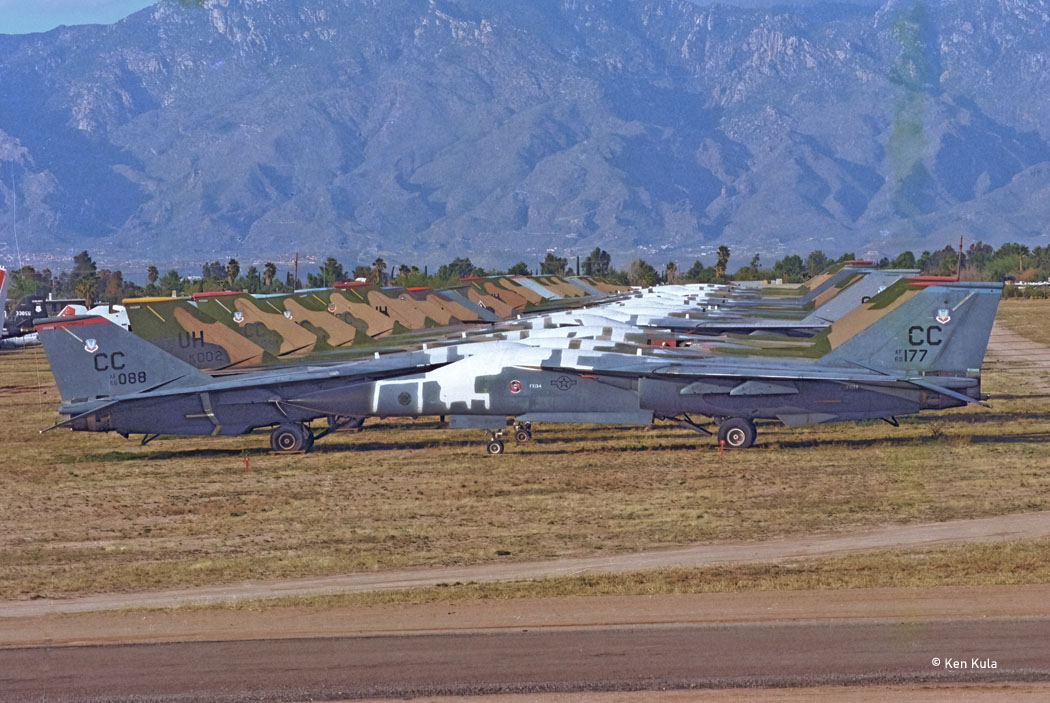
Various models of USAF General Dynamics F-111 Aardvark bombers are parked in storage at the Aircraft Maintenance and Regeneration Center (AMARC) located aboard Tucson Arizona’s Davis Monthan AFB.
Decades ago, the U. S. Air Force’s Military Aircraft Storage and Disposition Center (MASDC), later called the Aircraft Maintenance and Regeneration Center (AMARC) offered a once-a-month Saturday morning photo tour of the facility. The awe-inspiring ranks of stored aircraft, meticulously maintained in neat rows, made for some great photographic compositions. Tucson’s Mount Lemmon made for a great backdrop too.

The great fleet of stored B-52 bombers, which included hundreds of Cold War and Viet Nam War-era aircraft, contained many airframes whose missing parts were reclaimed for use on still-active aircraft. All of these B-52A through -G versions would ultimately be scrapped under the SALT Treaties.
Air Refueling Missions

The opportunity to fly in an aerial refueling tanker is a rare treat. The Blue Angels were the main attraction at a New Hampshire air show in 2010, and the 157th Air Refueling Wing of the New Hampshire Air National Guard met the F/A-18s over Raleigh NC and refueled them enroute, negating the need for an intermediate fuel stop on the ground. The picture window in the rear of the KC-135R tanker was nearly filled with the blue Hornet just tens of feet below.
Air refueling requires a complex plan that allows two (usually) dissimilar aircraft to safely meet and fly in a very close formation while transferring fuel. An air refuel initial point (ARIP) is where a receiving aircraft enters a published route, normally at a lower altitude than the tanker. The air refuel control point (ARCP) is where the tanker aircraft joins the route. Usually, the two (it could be single aircraft or groups in formations) cross the ARIP and ARCP at the same time. While at different altitudes, the aircraft fly towards each other, and at the right time, the tanker(s) makes a 180 degree turn which should put it just above the receiver(s), now flying in the same direction. The receiver then visually approaches the tanker and sits just behind and below the tanker’s tail. If a receiver has a probe-style receptacle, that pilot then visually catches the “basket” and once connected, fuel flows into the receiver. Otherwise, the tanker’s boom operator will fly the boom to place the probe into the receiver’s receptacle. The amazing process takes place some 50 or so feet in between aircraft, which are flying at speeds between 250 and 350 knots.

This giant C-5A Galaxy is moving into the “pre contact position” underneath a Maine Air National Guard KC-135 tanker. The receiver’s receptacle is in the outlined box just behind the cockpit. This early evening training mission took place in AR 631, an anchor refueling track which is contained in airspace overhead southern Vermont and New Hampshire. Our refueling altitudes were between nineteen and twenty-one thousand feet.
Edwards AFB Open Houses

This B-2 Spirit bomber is departing from Edwards AFB’s runway, heading northbound. This photo was taken from the east side of the base during the practice day of a weekend Open House air show.
Historic Edwards AFB has seen hundreds of aviation records set in the skies overhead. Although the west side of the runway contains most of nowadays’ activity and aircraft parking space, the east side is where the Bell X-1 was mated to the B-29 mothership with Chuck Yeager nestled inside the X-plane in 1947. While driving to and from our spot where this photo was taken, you could still see the concrete basement-like X-1 loading dock. Interestingly enough, the lighting on the east side of the base was better for photos than on the west side’s ramp where the main spectator area was.

Lockheed’s SR-71A Blackbird regularly flew out of Edwards AFB. The final publicly – displayed flights of an SR-71 at Edwards AFB were scheduled to take place during a weekend air show in 1999. NASA was the last operator of these SR-71s, for research purposes. This photo was taken at the end of the Saturday air show… the planned Sunday flight was cancelled due to a fuel leak on the ground. Thus, this photo was taken during the final public showing of a Blackbird. Here the NASA crew waves to the air show crowd as it taxies back to its parking spot at the Dryden Flight Research Center, aboard the base. The final flight of an SR-71 was the record-breaking delivery of a Blackbird from Palmdale’s Plant 42 to the National Air and Space Museum’s Udvar-Hazy facility at Dulles International Airport.
National Guard Exercise, Fort Drum, New York

On a hazy late-summer afternoon, a U. S. Army Bell AH-1 Cobra flies alongside a hill within Fort Drum, New York, which contains extensive practice ranges. A live-firing range is seen in the distance, above and behind the rotor blades. During this exercise, Cobras fired Hellfire missiles and 20mm cannons and an Army National Guard howitzer team was inserted into the range by UH-60 helicopters. The cannon team fired a few rounds and then were whisked away by the helicopters, taking just minutes from insertion to extraction.
I was very lucky to be chosen to take part in a military familiarization trip one summer day. We boarded a Connecticut Air National Guard C-12 Super Kingair and flew into the Wheeler Sack Army Airfield, in New York. We quickly boarded a flight of three or four UH-1 Iroquois helicopters and after some thrilling nap-of-earth flying (with the doors open and secured by lap belts), we arrived at an observation post to watch a live-fire demonstration. Since laser guided missiles were in use, cameras weren’t allowed for this part of the day. We watched ARNG AH-1s, and ANG F-16s and A-10s drop bombs and fire cannons. Then we hopped back into the UH-1s again and returned to Wheeler Sack AAF. On the way home (again in the Connecticut C-12), a pair of 103rd Fighter Wing’s A-10As formed up on our wing for some formation photos. The National Guard put on an impressive display that day!

A pair of Connecticut Air National Guard 103rd Fighter Wing A-10As fly in formation with our C-12 Kingair. Earlier in the day, the pair departed Bradley International Airport, utilized the firing ranges in Fort Drum, and landed at Wheeler Sack AAF. There, they reloaded ammunition and refueled at the 103rd’s Forward Operating Location (FOL) staffed by that unit’s Guardsmen. They departed, used the firing ranges again, and flew with us for about five minutes before going ahead and returned to Bradley. Thus, they made two training sorties out of a single day trip.
Red Flag Exercises, Nellis AFB

An Indian Air Force SU-30MKI-3 departs Nellis AFB during a Red Flag Mission. This was the first time the Indian Air Force and its SU-30s flew in a Red Flag mission. The exercise took place during some brutal heat (121 degrees Fahrenheit one afternoon), but these and the U. S. jets had more than enough thrust to counteract the hot air. Journalists were allowed to operate in between the pair of Nellis’ runways, gathering photos that told the story about how different air forces were working together to hone interoperability between themselves for the first time.
Red Flag is a storied exercise held up to four times per year; it pits flying units from several countries which work together against an adversary (usually a USAF aggressor unit). The Indian Air Force deployed a number of fighter aircraft, which were supported by IL-76 transports and IL-78 aerial tankers. All aircraft and crews flew during the exercise, allowing the participants to benefit from working with dissimilar procedures and equipment. It was exciting to see the Soviet-built hardware included in the 60+ aircraft flying in this period, and more interesting was the fact that these were operating on the same Blue Team as the USAF and several other allied countries.

In addition to the Sukhois and Ilyushins flying in Red Flags, from time to time other rare and surprising participants appear. According to one story, this NASA-operated WB-57F reconnaissance jet was acting as a high-altitude UAV with a sensor or communications pod in its payload bay which linked data between various aircraft participating in the training exercise.
Blue Angels Homecoming Air Shows, NAS Pensacola, Florida

Many of the Blue Angels’ team members are assembled in Pensacola as “The Boss” leads the jets out for what might be the last practice session of the year. This parade took place on a Thursday before the year’s final two air demonstrations at the Homecoming Air Show.
The final appearances for an air show season by the U. S. Navy and Marine Corps Blue Angel pilots takes place at their homefield airport, Forrest Sherman Field, at NAS Pensacola in Florida. The Blue Angels Homecoming Air Show traditionally was presented on a Friday and Saturday, with Sunday being the team’s first day off after a grueling schedule. For many team members, the Saturday show would be their last air show as a Blue Angel, and many could be reassigned or even retire from the Navy or Marine Corps after that. In many respects, the shows are emotional because of this finality. On a more lighthearted note, the air show’s arrival afternoon (usually a Thursday) offered a fantastic opportunity for photographers to capture behind-the-scenes photos of the team working at their home base. There was nothing casual about this, but in this season’s finale some non-standard situations occurred, like the above final team parade. Also, the air show ramp was normally cleared of most of the home-based aircraft for the show’s participating static display aircraft and for spectators, so it offered great, uncluttered aircraft photo opportunities with some wonderful “golden hour” lighting of the show’s static display arrivals.

A German Air Force Panavia Tornado taxies into its parking spot on the NAS Pensacola Ramp. Germany routinely participated in the air show with either F-4G Phantoms or Tornados, as the “back seaters” were trained at the Naval Air Station.
Red Flag Alaska Exercises

The U. S. Air Force’s Eielson AFB-based 18th Aggressor Squadron wears striking arctic camouflage on their F-16 jets. The squadron’s personnel and planes have travelled as far as Australia to train with allied nations.
Red Flag exercises pit opposing air forces against each other, with specific goals in mind for each team. Upwards of 60 aircraft will be airborne at any one time during these large training missions. Tactics are honed and lessons learned. Huge swaths of airspace are needed for pilots and controllers to operate and train in, and there are two specific areas in North America where these missions can be held. One place is over the desert in Nevada and California, the other is above the 49th State of the Union, Alaska. Red Flag Alaska is a unique training tool which brings together many American and Asian/Pacific countries together to practice their interoperability. This usually includes American forces stationed abroad (sometimes known as PACAF – or Pacific Air Forces), like those in Korea and Japan. Australia, New Zealand, Japan and other Pacific nations regularly participate, and in recent exercises European countries including Germany, Spain and Italy have exercised their interoperability too. The airspace is so large that two air bases support the flying. In the past, Anchorage’s Elmendorf AFB has usually supported larger aircraft such as E-3, E-767 and E-8 Wedgetail AWACS jets and some C-130s and tankers. Closer to Fairbanks, Eielson AFB supports the fighter activity and a lot of the tanker forces for the missions. Of note: the old Eielson AFB control tower contained Alaska’s second tallest elevator when it was in use, a more modern tower has replaced it now… but the view from the catwalk of the old tower was spectacular!

Red Flag Alaska affords many U. S. military units the opportunity to fly in and around unfamiliar surroundings, such as Alaska’s mountainous and rugged terrain. Photo credit: this FANG F-15 Eagle was photographed from the old control tower at Eielson AFB
WTI, MCAS Yuma, Arizona

Marines dash in front of a CH-53E Sea Stallion which has just landed and stands ready to take aboard a group of “non-combatants” in Yuma, Arizona’s Kiwanis Park.
The Marine Corps Weapons and Tactics Instructor Training Course (WTI for short) is administered at Marine Corps Air Station Yuma, Arizona. It is hosted by Marine Aviation Weapons and Tactics Squadron One, which is stationed at MCAS Yuma too. Years ago, I travelled to Yuma to observe the exercise and was offered the opportunity to get up close and experience how the course prepares instructors to teach other Marines to be Squadron Training Officers and Subject Matter Experts. A full-scale exercise would be conducted at the Kiwanis Park in Yuma, Arizona for a simulated Non-Combatant Evacuation Operation, or a Foreign Humanitarian Assistance Exercise, complete with Marine helicopters and ground troops. I was allowed by a Marine Corps media representative to get as close as safety permitted to record the action, which contained troops running feet away from me, and Marine CH-46, and CH-53D and -E helicopters thundering overhead. The cacophony of rotors slapping the air, jet engines’ whine and the shouting voices was exhilarating; I saw how chaotic an evacuation from a disaster or civil unrest could/would be. The Marines definitely looked in charge and well versed in running the operation in an orderly manner too. It was a truly impressive exercise that ran from dusk straight through till pitch darkness.

Departing from the Kiwanis Park grounds in Yuma, Arizona, this Marine CH-53D passed overhead with less than 100 feet to spare a few seconds later.
CFB Shearwater Nova Scotia Air Shows South Arming Ramp

Canadian Forces CH-124 Sea King helicopter, serial 124412, taxies back to parking at CFB Shearwater, Nova Scotia. The South Arming Ramp was a prime spot for aircraft photography as it was far from the airshow’s crowds. Note the Operation Friction Arabic numbers denoting “412” marks over the cockpit.
Back in the day, when Canadian Forces Base Shearwater was operating as both a fixed wing and helicopter base, their yearly Shearwater International Air Show attracted many NATO aircraft which attended the events. NATO had a training range at Goose Bay, Newfoundland and Labrador, and it was well within range for many tactical aircraft to attend over the weekend. That attendance was a major draw for air show fans, who otherwise couldn’t travel to Europe to see NATO aircraft in air shows. The base was also within range of many U. S. military aircraft and since Shearwater was a Canadian Navy base, the U. S. Navy was well represented. The South Arming Ramp near the runway’s end was usually full of the base’s aircraft during a show, including CT-133 Silver Stars, Canadair CT/CE-144 Challengers, and CH-124 Sea Kings – all of which would fly during the afternoon. After Operation Friction, some of the Sea Kings kept their (Desert Storm/Operation Friction) non-standard markings for a while and this was a great opportunity to photograph some of these.

This German Air Force JG 74 F-4F Phantom II touches down on the CFB Shearwater runway ahead of a Shearwater International Air Show. In the background, the red shack is part of the arresting gear, as are the yellow markings on the runway. This runway is closed today, as Shearwater has lost its fixed-wing aircraft, and is now only a heliport.
London International Air Show, London Ontario

A great special color scheme was applied to this and a few other Candian CF-116/CF-5 Freedom Fighters. The RCAF’s 419 “Moose” Squadron operated these CF-5s for a number of years, the aircraft to the left in this photo shows what the normal gray colors which the type routinely carried. The London International Air Show attracted many great color schemes and many fighters!
The London International Air Show of the 1980s and 1990s offered a coveted program for serious aviation photographers, the “Photo Pass”. For photographers, it was a rare chance to take photos of military aircraft while they were arriving and departing, but without the process of gaining clearance to enter a military base. The photographer’s pass allowed entry for the Friday arrival day, plus the two air show days – for a price. It was worth it! On the air show mornings, the special opportunity to go onto the grounds an hour or so before the general public was granted, allowing for static photos without people in them. Although ropes were strung in front of the aircraft, one could tip the stanchions over and get a clear photo, as long as you put them back up after we were done. Photographers were cordial and waited their turn if several wanted the same photo; a warm camaraderie ensued.

Although this photo was taken at a more recent air show in London, the characteristic radar dome in the background is a dead giveaway that this is London, Ontario’s airport. It is one of the very few landmarks which I like to see in photos, and if the viewer recognizes it, they too will know that it is indeed taken at London.


