British Aerospace BAe-146, AVRO RJ Etc. Scrapbook

Ansett New Zealand BAe-146-300
Story by Ken Kula, photos by the Photorecon Team
The United Kingdom’s Hawker Siddeley aircraft company launched a relatively small jetliner design in 1973. The HS-146 would be a high winged, 4-engined jet, originally planned to carry up to 70 passengers. Design work ramped up slowly due to the world’s economic crisis caused by the 1973 Arab oil embargo, but by 1981, the now-named BAe146-100 (British Aerospace emerged as the corporate entity in 1977) won its first orders. On September 3, 1981, the first prototype took to the skies on its initial flight. A second, larger version was also pitched to the world’s airlines as the BAe-146-200 variant, equipped with 15 to 18 additional seats, depending upon the cabin configuration. In 1984, an even larger version, dubbed the BAe-146-300, was offered to airlines with a dozen more seats than the now-standard -200 series.
Her is a bit of information and a photo of each main variant of the BAe-146 jetliner:

BAe-146-100 in Jersey European/Air France colors
The BAe-146-100 model could seat up to 82 passengers in a high density design. The four Lycoming ALF-502R-5 engines offered a very quiet operation, which opened runways at noise sensitive airports, especially during nighttime hours. Cruise speed was Mach .70, with a maximum speed of just under Mach .74. The jet was certified to fly up to FL350 (35,000 feet of altitude). A follow-on version, the RJ70 introduced a glass cockpit and different engines.

RAF 32 Squadron/Queens Flight BAe-146 CC.2
Several sub-variants were marketed, including the BAe-146-100 QC (Quick Change) and the BAe-146-100QT Quiet Trader cargo jet. The Royal Air Force acquired a trio of BAe-146 CC2 Statesman VIP versions, which served with the Queens Flight.

BAe-146-100STA (Side loading Tactical Airlifter) demonstrator jet
The BAe-146-100 STA was marketed as a military transport with a left side cargo door and air refueling capability.

AVRO RJ70 demonstrator jet
An improved version, with upgraded engines and a digital cockpit became the AVRO RJ70. Additionally, a FADEC (Full Authority Digital Engine Control) system was fitted.

BAe-146-200 in Flightline colors, originally delivered to the U. S.’s PSA airline
The BAe-146-200 version first flew in 1982. A later version, the -200A had different U. S. FAA certification features, but both of the aircraft variants are similar.

BAe-146-200QC demonstrator
Both the QC and QT versions of the -200 were offered on the larger -200 series design too.

BAe RJ85 in CityJet colors, once operated by Mesaba Airlines
The upgraded AVRO RJ85 was first delivered to customers in 1985, again including upgraded engines, FADEC and a digital cockpit.

BAe-146-300 during the late 1990s
The BAe-146-300 was another version with even more passenger seating, first announced in 1984 The largest member of the BAe-146 family could seat up to 112 passengers in a high density seating arrangement.

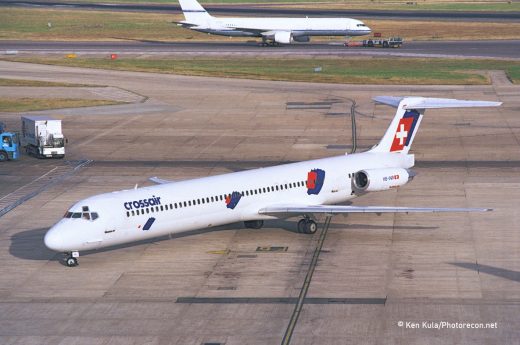
AVRO RJ100 in Crossair colors
The AVRO RJ100 was the follow-on version with upgraded engines, FADEC and a glass cockpit.
In all, 221 BAe-146 and 173 AVRO RJ and RJX airframes were built, totaling 394 aircraft. This production run began in 1981 and ended in 2001.

BAe-146-200 air tanker operated by Neptune Aviation Services
As airlines acted to replace the 25+ year old jets, several have been modified into aerial firefighting tankers, such as this Neptune Aviation BAe-146-200.
Here is a gallery with photos of many of the operators of this well-received jetliner. You can hover over each thumbnail for the version information: