“Doc” Visits Allentown

Story and photos by Corey Beitler, except where noted
Ideally located in the center of the Lehigh Valley, the Lehigh Valley International Airport serves the travel needs of residents of the surrounding communities and the major population centers of Allentown, Bethlehem, and Easton by offering flights to 15 destinations nationwide through four airline partners. Three cargo airlines also operate flights to and from the airport. With its two asphalt runways, ground facilities, a modern terminal building, and ramp space for passenger and cargo aircraft, the Lehigh Valley International Airport can handle any type of flight operations, including commercial, cargo, charter, corporate, military, medical, and general aviation.

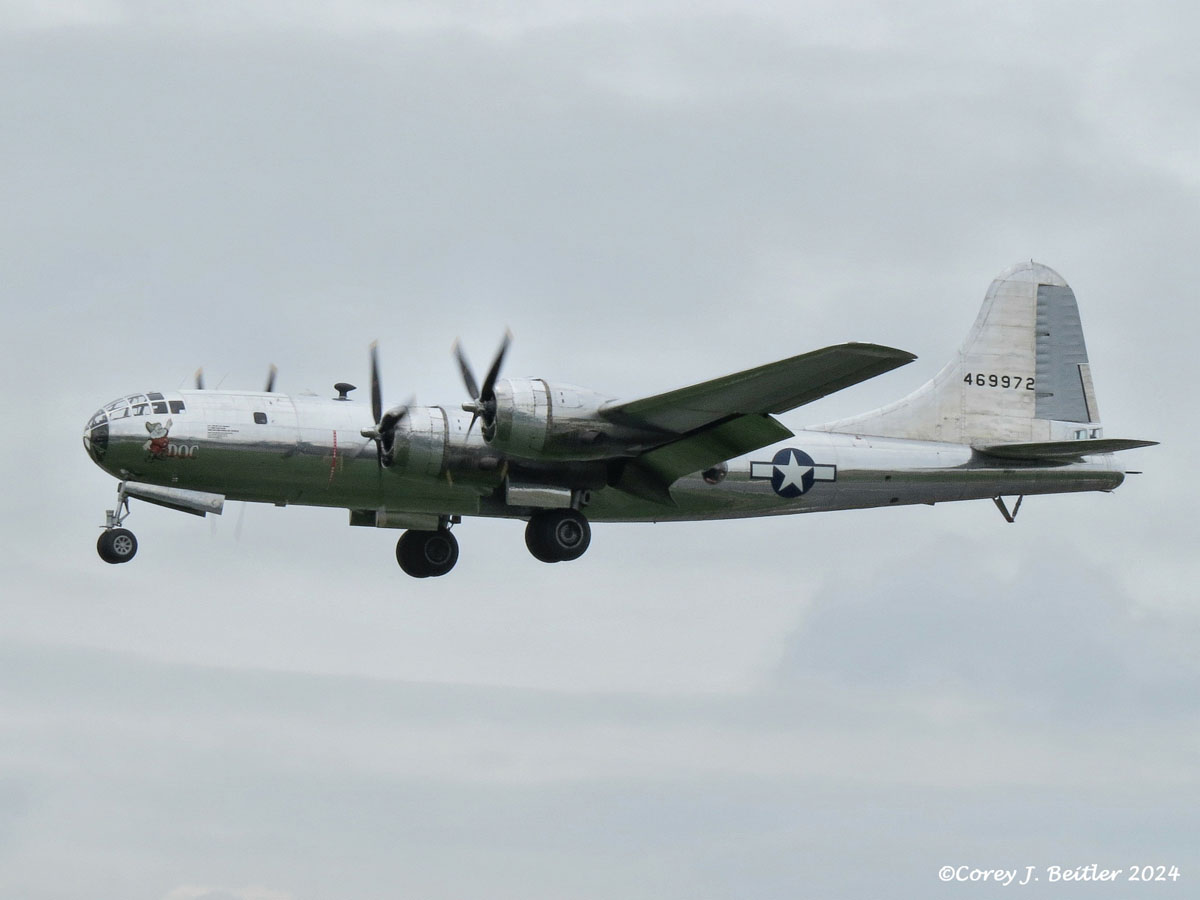
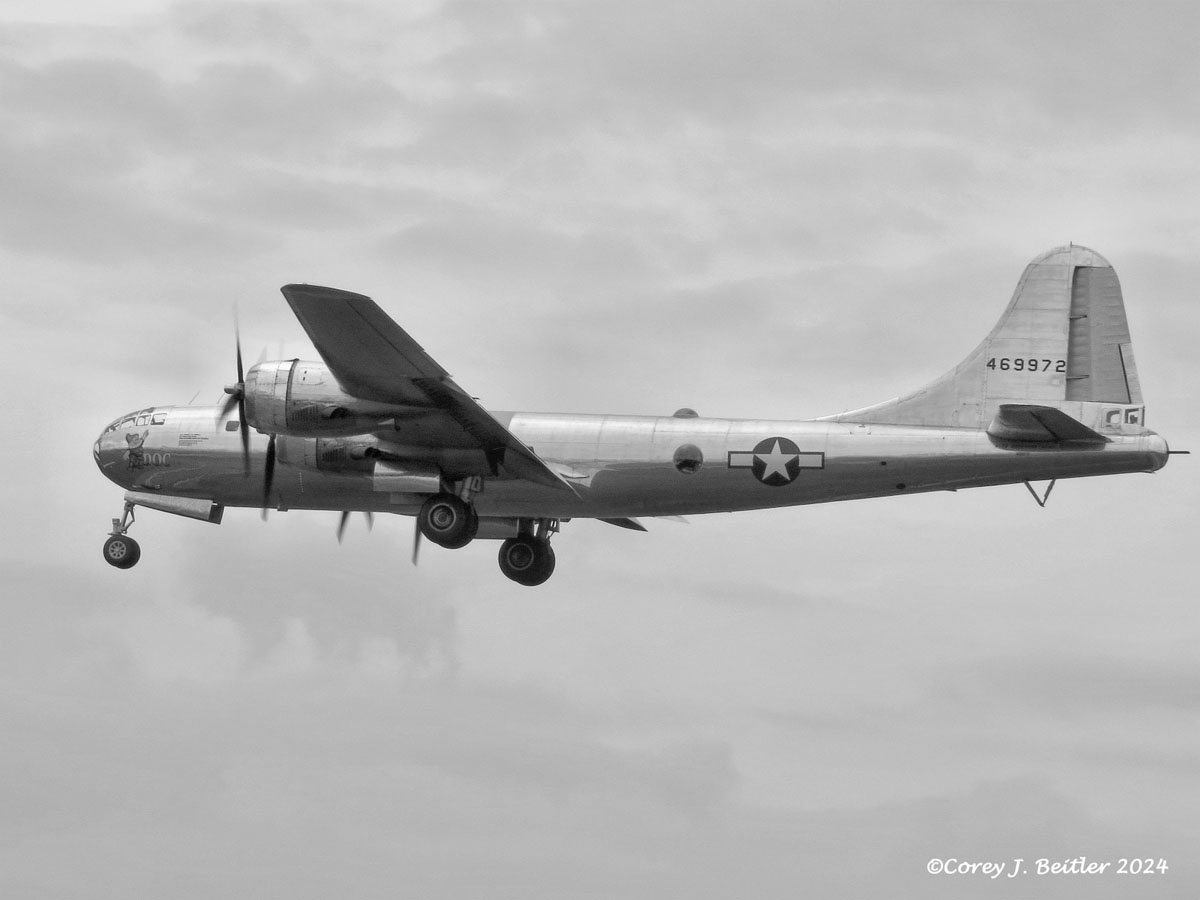
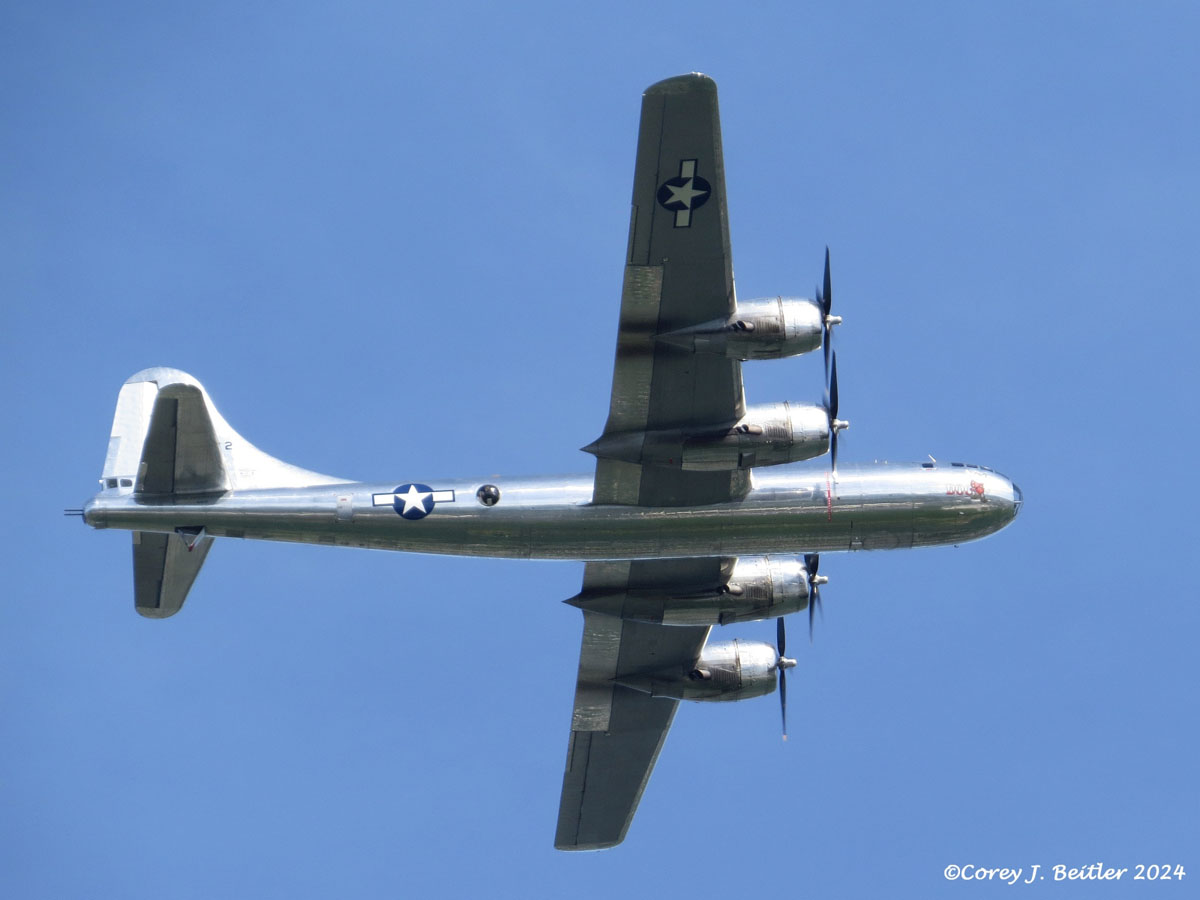
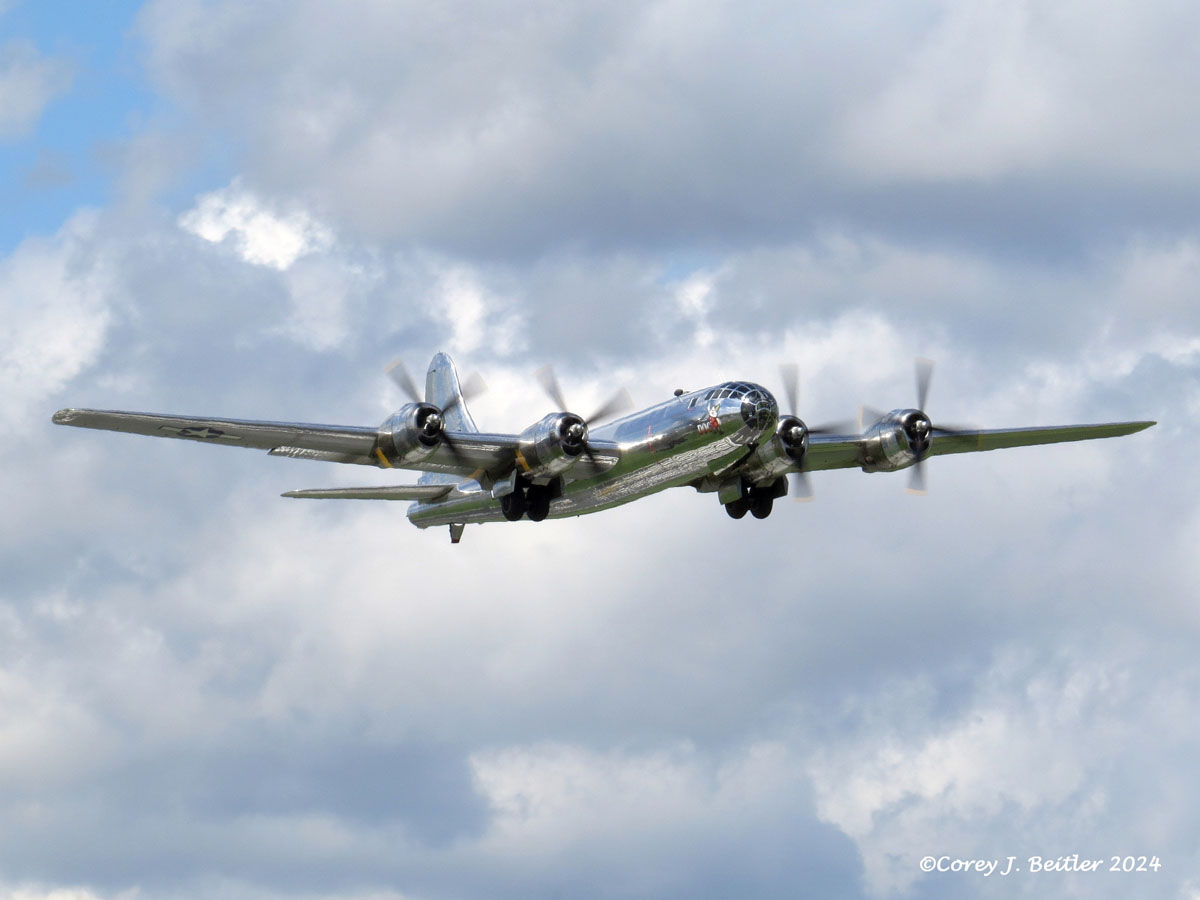
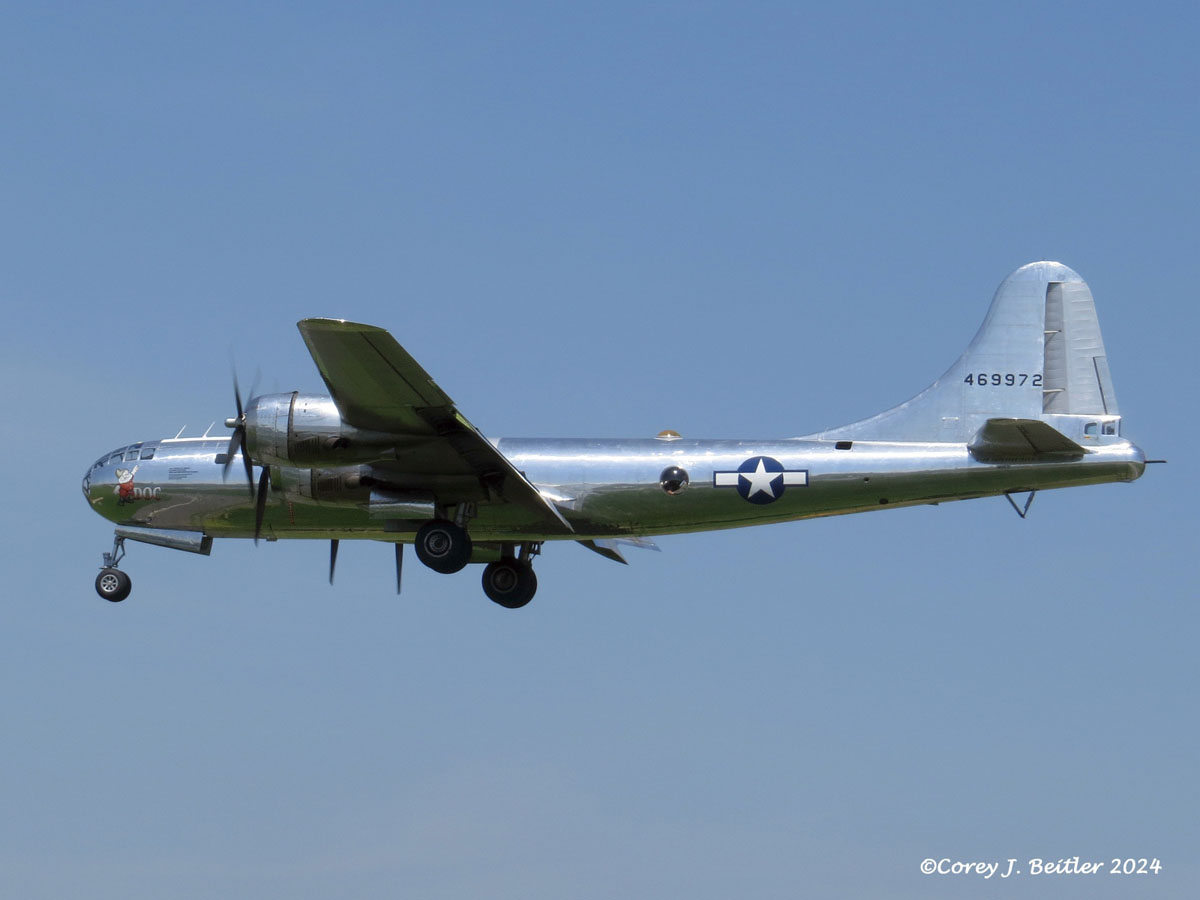
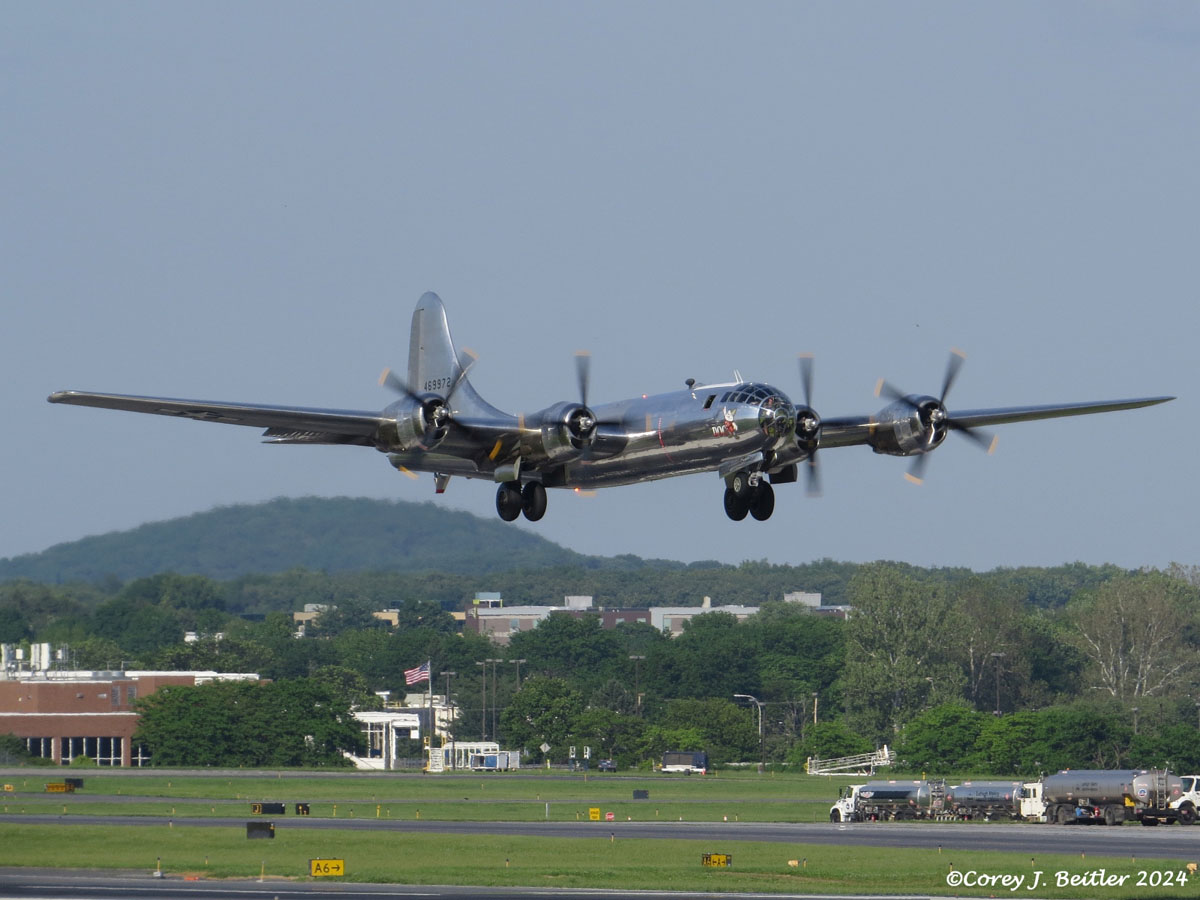
Recently, the Lehigh Valley International Airport welcomed an unusual visiting aircraft to its airspace, runways, and ramp. The restored Boeing B-29 Superfortress Doc operated by the non-profit organization “Doc’s Friends” visited Allentown, Pennsylvania, as part of its nationwide Doc: History Restored Tour. The tour stop allowed residents of Allentown and the surrounding Lehigh Valley region the unique opportunity to see one of only two airworthy examples of the B-29 Superfortress World War II heavy bomber up close, tour the cockpit, and even fly on Doc during a warbird experience flight.
The Boeing B-29 Superfortress is an American four-engine heavy bomber. With a wingspan of just over 141 feet and a length of 99 feet, the B-29 was the largest bomber to see service during World War II and also saw combat in the Korean War during the early 1950s. Designed for high-altitude bombing, the B-29 had a top speed of 357 miles per hour, could carry 20,000 pounds of ordnance , fly as high as 31,000 feet, and had a range of over 5,300 miles. In addition to high-altitude bombing, the B-29 was used for dropping incendiary bombs on cities and industrial areas and naval mines to blockade harbors and ports. The B-29 Superfortress is most famous for its role in dropping the atomic bombs on Hiroshima and Nagasaki, which helped convince the Japanese government to surrender and bring an end to World War II. The B-29 Superfortress is the only aircraft ever to drop a nuclear weapon in combat.

The B-29 Superfortress was designed with state-of-the-art technology for its time, including a pressurized cabin to allow operations from high altitudes, dual-wheeled tricycle landing gear to support its size and weight, and an analog computer-controlled central fire control system that allowed a fire control officer and two gunners to direct defensive machine gun turrets at four locations on the aircraft. Another advanced feature of the B-29 was its Norden bombsight, which combined optics, a mechanical computer, and an autopilot to identify a target and fly the airplane to it while compensating for wind and other weather effects. The aerodynamic shape of the B-29’s fuselage also allowed it to fly faster, farther, and higher than previous bombers.
The Boeing B-29 Superfortress flew for the first time on September 24, 1942. An advanced design with challenging production and operational requirements, the B-29 proved complex and expensive to build, and the aircraft became subject to many delays and setbacks as technical issues were discovered and solved. Boeing and its subcontractors incurred many cost overruns as they struggled to get the B-29 into service. Many B-29s were sent straight from the production line to repair depots for modifications. As a result, the B-29’s entry into service fell behind schedule.

The major cause of the maintenance headaches was the B-29’s engines. The Wright R-3350-23 Duplex Cyclone radial engine was plagued with reliability problems. Engine fires and catastrophic failures were common. Measures to fix the engine problems and get the B-29 into operational service included cuffs placed onto the propeller blades to divert more cooling air into the intake, increasing oil flow by installing baffles and rubber pushrod fittings to reduce oil loss, and replacing the uppermost valves of the engines as well as entire engines more frequently. Although these measures improved engine reliability, the engine issues were never fully solved until the B-29D/B-50 Superfortress was developed, which used the more powerful Pratt & Whitney R-4360 radial engine as its powerplant.
The B-29 was officially introduced into service in May 1944. Initially, B-29s were based in China and used for raids against Japanese targets in Singapore and Thailand. Some early B-29s were stripped of their defensive armament and converted into bulk fuel tankers to keep Allied forces supplied with fuel in the China-Burma-India theatre of operations. Eventually, the B-29s moved to airfields on the Pacific islands of Guam, Saipan, and Tinian. From these new airfields, B-29s were used for large-scale bombing raids against the Japanese home islands and mainland Japan. B-29s were also deployed to drop mines to blockade major Japanese ports and prevent the movement of supplies by sea.
The most famous B-29s were those that were part of the Silverplate series. These B-29s were extensively modified to carry nuclear weapons. Some of the modifications made included enlarged bomb bays, fuel-injected engines, and reversible pitch propellers. In 1945, two of the Silverplate B-29s were used to drop nuclear weapons on Japan. On August 6, 1945, the B-29 Enola Gay dropped the atomic bomb Little Boy on Hiroshima. Three days later, on August 9, the B-29 Bockscar dropped the bomb Fat Man on Nagasaki. Although the use of these weapons remains controversial because of the loss of life and devastation they inflicted, they did persuade the Japanese government to surrender and end the war. Using the two atomic bombs also saved thousands, if not millions, of lives. Operation Downfall, the planned U.S. invasion of mainland Japan, would have cost the U.S. military an estimated 500,000 to over 1 million casualties. Japanese military and civilian losses were predicted to be even higher.

Production of the B-29 ended after World War II, and surplus examples were phased out and scrapped. Some B-29s remained in inventory and equipped the bomber squadrons of Strategic Air Command when the U.S. Air Force was formed in 1946. The B-29 was also used in specialized roles, such as air quality sampling during nuclear weapons testing, a mother ship to drop research and test aircraft at altitude, and weather reconnaissance.
The B-29’s final use in combat was during the 1950-53 Korean War. Initially used in daylight bombing raids, B-29s were quickly switched to night operations with the appearance of MiG-15 jet fighters in North Korean skies. Targets attacked in B-29 bombing raids included bridges, dams, and industrial centers. During the Korean War, the B-29 flew 20,000 sorties and dropped over 200,000 tons of ordnance. B-29s were also used during the Korean War in the reconnaissance role and for leaflet drops.
The final development of the B-29 Superfortress was the B-50 variant, initially designated the B-29D. The B-50 was fitted with more reliable and powerful Pratt & Whitney R-4360 radial engines. These new engines finally cured the various engine issues that had plagued the B-29 through most of its service life. Other improvements introduced on the B-50 variant included a strengthened structure, a taller tailfin, and a steerable nosewheel.
Introduced in 1948, the B-50 served in the U.S. Air Force for over 20 years. After its use as a strategic bomber ended, the B-50 was modified and used for other roles. Several were modified to become air refueling tankers for Tactical Air Command and others for air-sea search and rescue missions. The last B-50s in service were modified examples used as weather research aircraft for the Air Weather Service. These B-50s were retired in 1965 after extensive corrosion was found in their airframes.

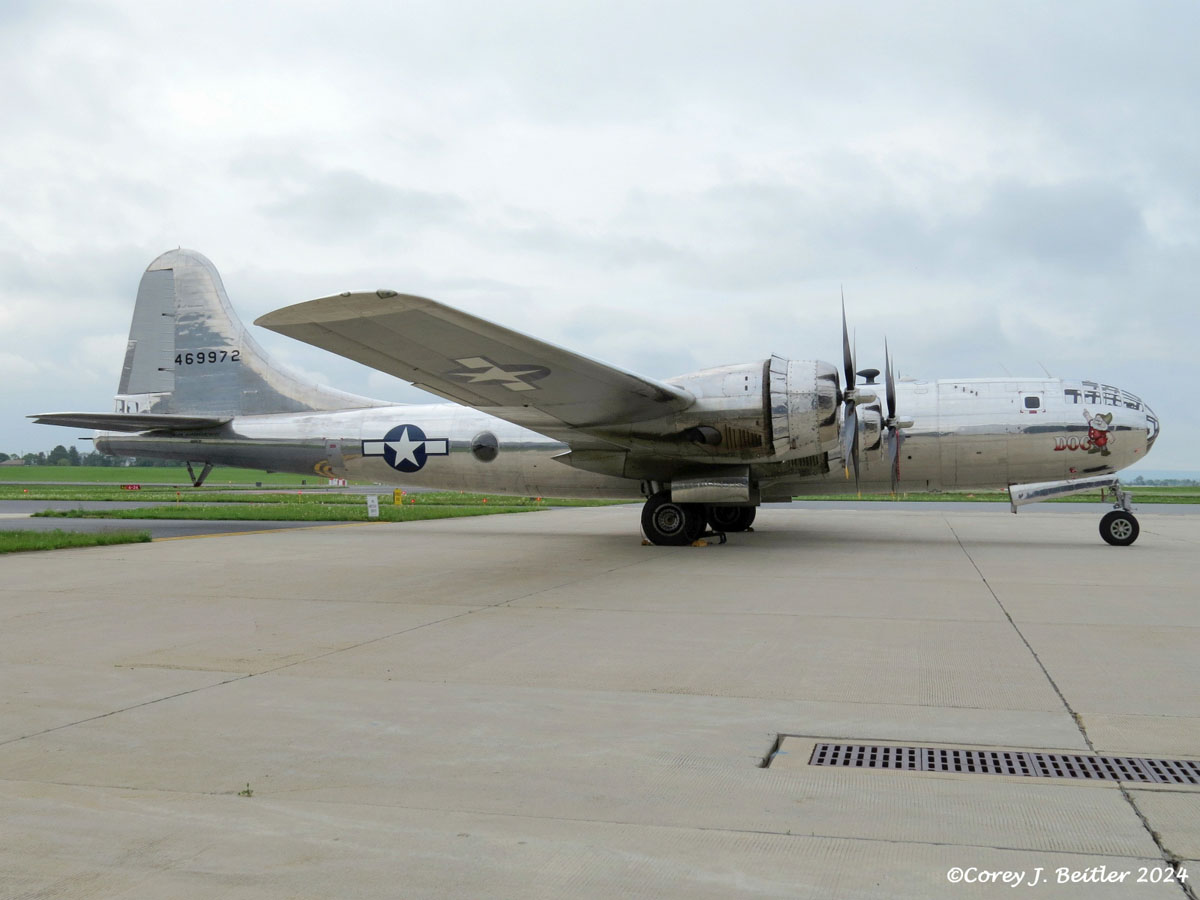
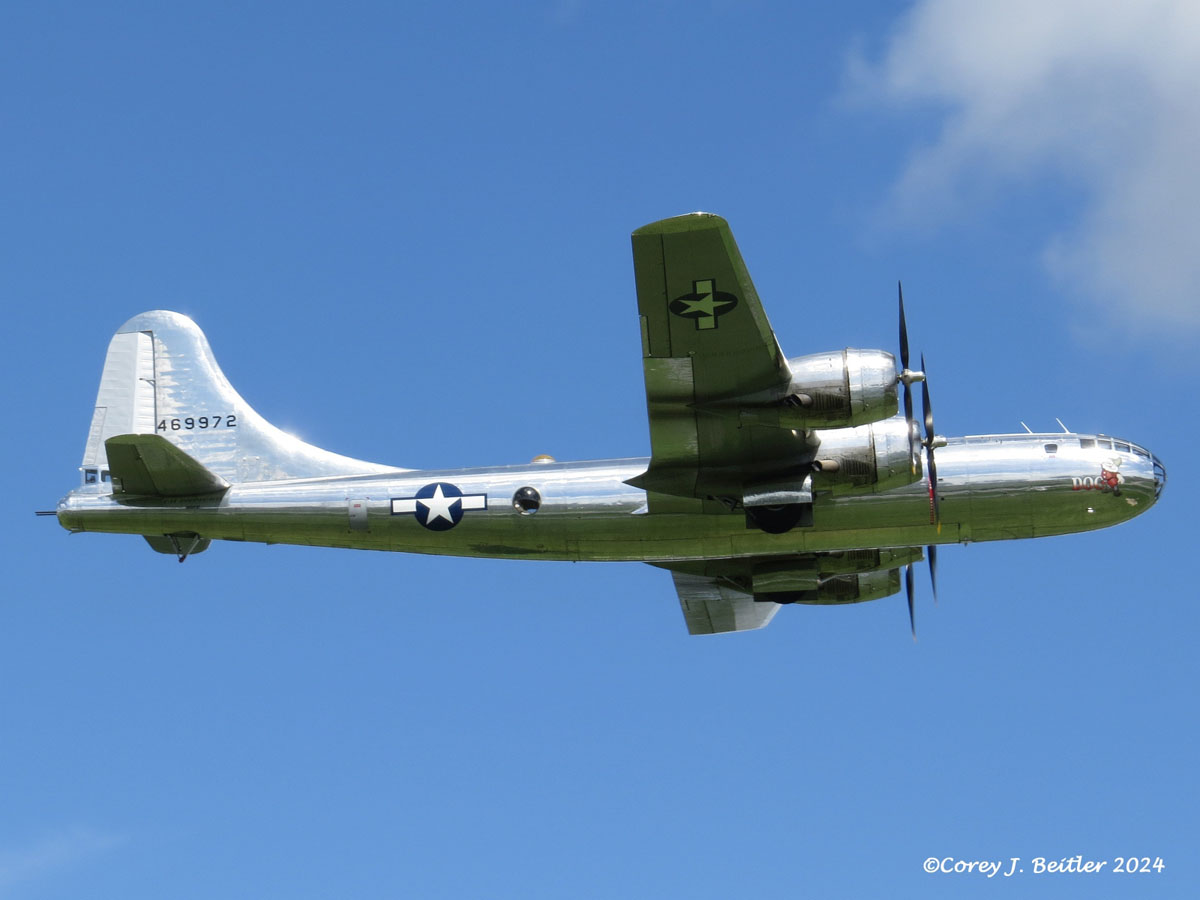
Doc is one of only two airworthy B-29 Superfortresses in the world today. The B-29 was built in 1944 at Boeing’s Wichita production facility and assigned military serial #44-69972. The B-29 was delivered to the U.S. Army Air Corps in March 1945 and arrived in the inventory too late to see any combat in World War II. In 1951, the B-29 was converted into a radar calibration aircraft. While operating in this role, the B-29 was assigned to the Griffiss Air Force Base in New York. When stationed at Griffiss, the B-29 flew as part of the 1st and 2nd Radar Calibration Squadrons. The squadrons named their aircraft after the characters of Disney’s Snow White and the Seven Dwarfs, and B-29 #44-69972 became Doc.
In 1955, Doc was modified again and became a TB-29, a B-29 used to tow targets. Doc was moved to the Yuma County Airport in Arizona for this role. After serving as a target tug for a year, Doc was retired by the U.S. Air Force in 1956. The B-29 was sent to the Naval Weapons Station China Lake for use as a target in testing missiles and other weapons systems. Doc sat for years in the Mojave Desert, rotting away until being discovered in 1987 by Tony Mazzolini. Mazzolini worked for 12 years with numerous officials in the U.S. Government to take possession of Doc and develop a plan to rescue and restore the airplane. In 1998, Mazzolini and his team towed Doc out of the Mojave Desert. In 2000, Doc was transported to Wichita on flatbed trailers so the long restoration process could begin.

The restoration of Doc would take hundreds of volunteers over 450,000 hours during an over 15-year period. The restoration proceeded slowly and fell behind schedule as money was raised to complete the project, and rare components were sourced, fabricated, or rebuilt. In 2013, a group of Wichita aviation enthusiasts and business leaders formed Doc’s Friends, a non-profit organization to manage the restoration project and see it through to completion.
During the restoration process, a decision was made to change Doc’s engines. The initial versions of the Wright R-3350 engine used on the B-29 Superfortress were notoriously unreliable and prone to failure. Later versions of this engine had the initial design problems solved and had improved reliability. The improved versions of the R-3350 were used successfully on many commercial and military aircraft in the late 1940s and early 1950s.
Doc’s restoration team decided on a hybrid engine to power the B-29. The engine is a cross between the Curtiss-Wright R-3350-95W and R-3350-26D radial engines. The rebuilding and combination of these two engines gives Doc the power of the R-3350-95W engine but the durability of the R-3350-26WD engine. These engines were chosen for Doc because the parts for them are still widely available.
In 2015, the restoration team successfully completed startups and test runs on all four of Doc’s engines. By May 2016, Doc was ready for and completed low-speed taxi tests as final preparations were made for the B-29’s return to flight. These tests were the first time since 1956 that Doc moved under its own power and allowed the restoration team to be able to test the brakes and steering. After receiving an airworthiness certificate from the Federal Aviation Administration (FAA), Doc was ready for a test flight. Doc’s first test flight occurred on July 11, 2016. The restoration team then spent the remainder of 2016 addressing minor technical issues with Doc and conducting additional test flights. In 2017, Doc flew its first airshow and tour season, attending eight airshows in four states, including the world-famous EAA Airventure in Oshkosh, Wisconsin.
After the restoration of Doc was completed, the next step for Doc’s Friends was to build the B-29 a permanent home. The organization envisioned a large hangar where Doc would be safe from the weather, and the team could perform maintenance on the B-29 in the airshow and tour off-seasons. Doc’s Friends also wanted to incorporate an education and visitors center into the hangar where the public could learn about Doc and the history of the B-29 Superfortress.
Doc’s Friends broke ground on the 42,000-square-foot hangar in September 2017. Major construction on the new facility began the following March. Because the priority was to build a structure to protect the Doc from the elements when the aircraft was not on tour, the hangar was built first. The hangar was completed in November 2018. Work then proceeded to finish the Education and Visitors Center. In January 2019, the B-29 Doc Hangar, Education & Visitors Center was dedicated and officially opened to the public. Since its opening, the B-29 Doc Hangar, Education & Visitors Center has welcomed thousands of aviation and World War II history enthusiasts through its doors. The facility has also held several private events, including seven high school proms and a dance recital.

Today, Doc continues to fly across the nation on its annual Doc: History Restored Tour. The tour takes place from early April to September and provides people the opportunity to learn about the B-29 and its history, see the aircraft up close, and take a ride in it as part of a warbird experience flight program. The total amount of the proceeds from the ride flights, ground tour fees, merchandise sales, and donations go towards Doc’s operating and maintenance costs, which are substantial. It costs about $5,000 an hour to fly Doc, with significant costs being fuel, oil, maintenance, spare parts, and insurance.
Doc also makes appearances at various airshows throughout the United States as either a static display exhibit or by flying an airshow demonstration. The mission of Doc’s Friends is to Honor, Connect, & Educate through the B-29 tour stops and airshow appearances. The organization strives to honor the men and women who sacrificed so much for the freedom of others, including those who designed, built, and flew the B-29 during and after World War II. Another mission of the organization is to connect people with the rich heritage of the B-29 and allow aviation enthusiasts to experience the thrill of a B-29 up close. Finally, the organization strives to educate today’s and future generations on the contributions of the Greatest Generation during wartime.
The B-29 Superfortress Doc arrived at the Lehigh Valley International Airport for its Allentown tour stop on the afternoon of May 6 after a flight from the Newport News/Williamsburg Airport in Virginia. The visit to Allentown is one of 16 tour stops or airshow appearances Doc is making in 2024 as part of its Doc: History Restored Tour. The rumble of Doc’s radial engines made the B-29’s presence known as it entered the landing pattern at the airport. After arriving at the airport, the B-29 was parked, and the flight crew and tour team departed for some much-needed time off before Doc’s tour days and ride flights at Allentown later in the week. Ground and cockpit tours were offered on Thursday, Friday, Saturday, and Sunday, and warbird experience flights were offered on Saturday and Sunday.
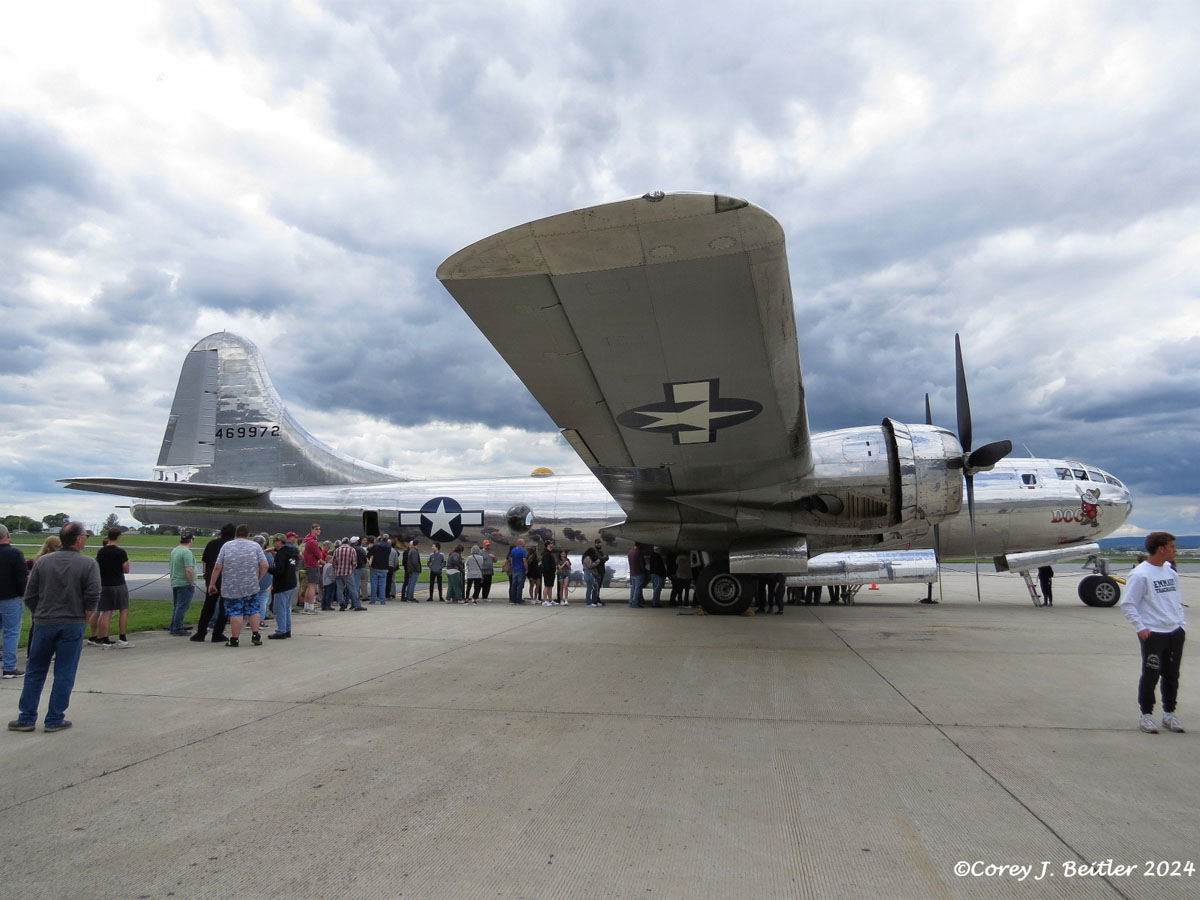
The Doc: History Restored Tour received an excellent reception in Allentown. A steady stream of people of all ages lined up for ground and cockpit tours each day of the Allentown visit. Despite the rainy weather on Friday and again on Sunday, people still made the trip to the Lehigh Valley International Airport to visit the B-29 Doc. On Thursday morning, local media had the opportunity to tour Doc and interview the flight crew and tour team. The Doc: History Restored Tour merchandise team was also busy and by the end of the tour stop, had almost sold entirely out of T-shirts, patches, posters, and magnets.
For those who decided to tour Doc on the ground, the restored B-29 Superfotress offered plenty to see. From the outside of the aircraft, people could view Doc’s four engines, massive tail, and tail gun turret. Popular stopping points for pictures were next to the nose of the B-29 with Doc’s colorful dwarf nose art illustration or next to the massive propellers. Doc’s flight crew and support team were also on hand to answer visitor questions.
 Touring the inside of Doc allowed people to see some of the key parts of the B-29 Superfortress. The tour began with a look inside one of the two bomb bays on the B-29. Reproductions of each type of bomb that the B-29 could carry hang in the bomb bay, so that people can appreciate the different sizes of each type. The bomb bay also has a surprise in the form of a spare tire for Doc’s main landing gear. Doc’s flight crew explained the tire is carried in case one needs to be changed on location so they do not have to wait to have one shipped to them. A spare nosewheel tire is also carried aboard Doc.
The tour of the inside of Doc ends behind the cockpit. From this spot, the pilot, copilot, flight engineer, navigator, and bombardier positions are viewable. The amount of instrumentation for each crew position is impressive. Also visible from the cockpit is the crew access tube, which was used for crew movement between the front and rear of the B-29. This tube, just wide enough for an average-sized man to climb through, was needed because the B-29 was pressurized, but the bomb bays were not.
In addition to the ground and cockpit tours, warbird experience flights were also available aboard Doc during its visit to Allentown. These rides last about 30 minutes, and people can buy different seat positions on the aircraft, which vary in pricing. These ride flights sold out soon after Doc arrived in Allentown. The response for rides was so positive from the Allentown tour stop that after an appearance at the First State Airshow at Dover Air Force Base on May 17-19, Doc returned to the Lehigh Valley International Airport on May 20-21 to offer additional warbird experience flights to the Allentown area. These ride flights also sold out, making the Allentown visit one of the most successful tour stops ever for the Doc: History Restored Tour.
In addition to touring the B-29 on the ground, many wanted to see Doc in flight. During the warbird experience flight days, people staked out spots at various businesses and public access areas around the Lehigh Valley International Airport to capture glimpses of Doc in flight or taking off and landing at the airport. Some of these people came from as far away as New Jersey to see Doc and appreciate aviation and World War II history.
The B-29 Superfortress was the largest aircraft to see service during World War II and one of the most advanced bombers in the world when it was introduced into service. Although it only served in the Pacific theatre, the B-29 played a pivotal role in ending World War II. The number of people who visited the Lehigh Valley International Airport for the Doc: History Restored Tour demonstrates that interest in aviation and World War II history remains high. For some visitors to Doc, it was connecting with a relative who served in World War II. For others, it was educating their children about our past. Many visitors were aviation enthusiasts, wanting to see a rare airworthy example of a B-29. Although interest levels in Doc varied for each visitor, one thing was clear, the response to the tour stop from the public in the Allentown and Lehigh Valley region shows that Doc’s Friends will be plenty busy on the Doc: History Restored Tour for several years to come.

Above photo courtesy of Nick Chismar.