

Firewalkers International

Story by Daniel O. Myers, photos courtesy of Firewalkers International (used with permission) and Bob Finch
For Rick “Sarge” Myers it all began in 2002 while working as the Base Weapons-Ground Safety Officer at Mountain Home AFB, ID. As a non-commissioned officer (Master Sargent), it was Rick’s job responsibility to check-in outside personnel/vendors that were transporting explosives onto the base. When Rich Gibson showed up with 100 pounds of dynamite, to be used at the upcoming air show, it drew more than idle scrutiny from Master Sergeant Myers. Gibson further explained to Rick that his company, “Rich’s Incredible Pyro,” had safely perfected a method for setting off a line of high explosives just 100 feet apart from each other. By now, if Rick wasn’t already paying mind to Gibson’s truckload of explosives and what he was going to do with them, that assertion really got his attention! At that time, no one ignited explosives without at least 1,000 to 1,200 feet of separation. That was commercial and military standard operating procedure.
During that initial air show, Rich Gibson demonstrated that he had indeed perfected his method and Rick was convinced. While USAF senior officers remained skeptical, Rick was able to sway their concerns. In so doing, as an active-duty military NCO, Rick was then assigned as an Explosive Safety Officer in support of the military attached to Rich Gibson and his company’s team when executing pyrotechnics demonstrations at air shows. For the next ten years, Rick and Rich traveled together to thirty-two air shows- codifying their professional relationship. In 2013, Rich Gibson decided to retire and turned over his company along with his team of employees to, a now retired-from-the-military, Rick Myers.
Long before a pyrotechnics team shows up at an air show, there is up to a year of preparation and notice. As Rick states, “After all, you don’t just show up, cap it, and blow it up!” Pyrotechnics Special Effects contractor guidelines are laid out in the ICAS Pyrotechnics Safety Manual. ICAS strongly recommends that all air show promoters/organizers employ only contractors meeting the minimum requirements set out by ICAS for airshow Pyrotechnics Special Effects. First, the pyrotechnics company must inform the air show promoters and venue of their intentions. The contractors are also required to locate and, use storage facilities and modes of transportation that comply with local, state, and federal laws. Sometimes, local quarry, construction or excavation companies that have access to approved storage containers may be employed. After approval by the show promoters/organizers and venue, a lot of paperwork needs to be filled out. Not the least of which is notifying the necessary local, state and federal authorities. The air show sponsor is also required to meet with local airport authorities and the Fire Marshall.
The ICAS Pyrotechnics Safety manual first published in1998 and currently in its sixth iteration, serves as the guidelines used by air show performers, sponsors, and producers. The ICAS safety manual was first authored by Rich Gibson, based on the commercial explosives industry’s safety guidelines. The manual is a reference source guide containing information intended for the regulations and requirements that have to be met when explosives, special effects, and pyrotechnics are introduced into the air show environment throughout North America. The definition of ground-based pyrotechnics or special effects as described in the manual is; explosive materials and/or fuel detonated to represent mock bombings, strafing runs, napalm, etc. Special effects explosives work at airshows requires special training and knowledge that CANNOT be gained simply by the commercial application of explosives in quarrying, mining, or construction, nor by the casual use of explosives in an agricultural environment, nor through military explosives training, Airshow special effects explosives use requires careful research, testing, training, and experience specifically on the use of these materials for special effects purposes in an airshow environment.

Those Pyrotechnics Special Effects contractors participating in air shows are required to possess an ICAS Shooter in Charge (SIC) certification as presented in the ICAS Pyrotechnics Safety Manual. The ICAS manual defines a qualified airshow Shooter in Charge (SIC) as an individual that:
a. Possess a Federal ATF permit as a permanent user of explosives material.
b. Have a minimum of three years apprentice experience under a qualified SIC working with special effects explosives at airshows including set-up and shooting of special effects explosives at a minimum of twenty airshows.
c. Be thoroughly trained by a currently qualified SIC in all FAA and other aviation related regulations.
Both the United States Air Combat Command (ACC) and 1 Canadian Air Division Air Force demo teams have requested ICAS to produce an annual list of individuals qualified to meet the ICAS pyrotechnics/special effects guidelines; demonstrating both sufficient experience, judgment and record of safety. This list of pyrotechnics/special effects contractors, known as the ICAS Qualified Shooters-in-Charge List, is compiled annually by the ICAS Qualifications Review Group Safety Committee. Only those Shooters-in-Charge selected by the ICAS Pyrotechnics Safety Subcommittee will be allowed to work with the USAF ACC and 1 Canadian Air Division demonstration teams. Both the USAF ACC and 1 Canadian Air Division publish specific regulations and requirements for the use of pyrotechnics with their respective jet demo teams. These regulations include specific references to the amount and type of charges allowed, daily briefing procedures and requirements, communication protocols, and other safety related procedures.
Before charges can placed on the air show field, an appropriate location must be selected and the site prepared. A preferably location is show center, 500 to 1200 feet from the crowd line, depending upon the type acts performed (high speed, low speed, etc.). At all Air Force Bases, pyrotechnics must be set up at a minimum of 1250 feet from the crowd line. If grass and other vegetation are present, they should be burned off at least one week prior to the show. If it is not practical to burn off the area, any vegetation should be cut as short as possible and then removed from the area. Not pre-burning or removing vegetation from the pyrotechnics area is the single biggest problem for pyrotechnics special effects contractors at show sites. Burning vegetation with even moderate winds can create an out-of-control grass fire that can stop or delay an air show while the fire is brought under control. There should also be a firebreak at least 50 feet wide between the spectator and the pyrotechnics areas. Runway, taxiway, road or tarmacs may serve that purpose. If no such firebreak exists, it is highly recommended to scrape, plow or disk the soil clean of vegetation with the use of a construction grader. The pyrotechnics area should also be free of any airport equipment or other items that may be sensitive to explosives. Also, there must be a pre-coordinated plan for dealing with fires.

Show Preparation
The Firewalkers International team show up at the airfield to start explosive laying preparations six hours prior to the show’s first shot. That means, if the usual first shot is 11:00 am, the team is on location and working by 5:00 am! The Firewalkers consist of twenty members but a usual team compliment for an air show is a minimum of six and up to ten depending on the size of the show. Several team members are ICAS certified pyrotechnics shooters (SIC) and are available to cover in case the appointed SIC for the day is unable to participate. Along with the Firewalkers, there are a cast of up to ten volunteers to help Rick and his team. The air show promoters are responsible for lining up those weekend volunteers. Each volunteer must be physically able to lift and carry repeatedly, have no health issues aggravated by smoke or dust and be able to move unencumbered in the event of an emergency. All volunteers must be available and able to work each performance (practice and show) day. If they fulfill all of their requirements, at the end of the weekend, they each receive an orange Firewalkers International tee shirt. It is a most coveted prize!

Show Time
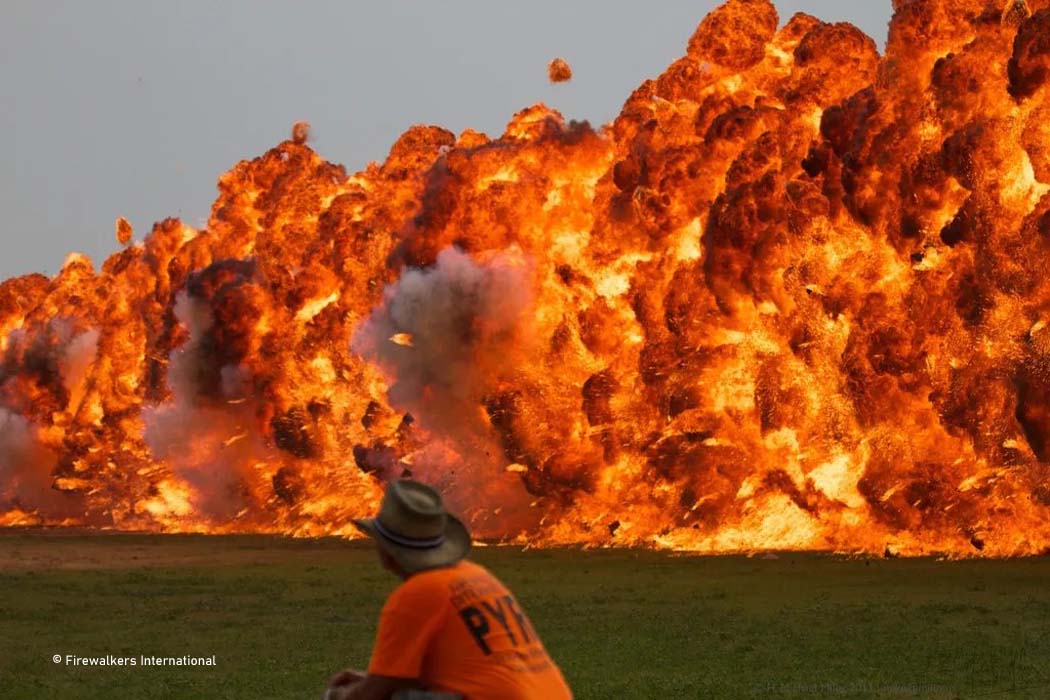
Now that the field charges have been set, it’s show time! However, like all other show performers and participants, the designated Shooter in Charge (SIC) must attend all airshow briefings. Rick (or another designated SIC) takes his/her position alongside the Air Boss, Announcer and demo team’s Safety Officer on the Air Boss stand. The Air Force and Navy have strict requirements for pyrotechnics and can only be executed on certain passes. Safety and, the effects the explosives and smoke can have on the demo jet must be taken into consideration. For the Navy and ACC jet demo teams, each pyrotechnics shot is written into the jet’s demo routine syllabus for certain maneuvers/passes. However, each shot must still be confirmed by the jet demo pilot or safety officer prior to the maneuver with a radio check from the SIC. The demo pilot calls all shots however, he/she may delegate this to his safety observer for confirmation before the shot is taken. Radio contact will only be initiated by the demo pilot or safety observer, and under no circumstance will the SIC talk directly to the pilot unless safety of flight becomes an issue. Once confirmed and approved, the Safety Officer will call “Hot Pass” and then and only then will the SIC relay “Hot Pass” to the shooters in the field for the particular charge to be fired- Mock Bombings, Strafing Runs, Napalm or “Wall of Fire.” Bombs, Napalm, or “Wall of Fire” simulate the dropping of ordnance with the aircraft continuing to fly past the explosion area prior to detonation. Rocket or Strafing Passes are pyrotechnic events that happen in front of the aircraft. The “Wall of Fire” has a maximum length of 2,000 linear feet, while a strafe passes may have up to a series of forty charges fired. Helicopters and Harrier demonstrations hovering over or landing near a live pyrotechnics/special effects area is strictly prohibited.

Firewalkers International only demonstrates pyrotechnic special effects at air shows. Owner Rick Myers claims, non-airshow venues are just to too small for the value. Since 2013, exclusive of the COVD-19 years (2020 to 2021), the Firewalkers International schedule of air show appearances has continued to grow each year. Rick says none of that is by design. Instead, as word of his company’s excellent reputation has spread, air show promoters have contacted him, inviting his company to demonstrate at their venues. And competition from other pyrotechnics companies is not an issue. There are about five other companies in the industry. Rick calls them “Friendly Competitors.” With hundreds of annual air shows, there is plenty of work for everyone. If a particular pyrotechnics company is requested to participate at a show but for some reason is not available to work that venue, they call one of their fellow friendly competitors and offer them the show. Rick says these show trade-offs are not uncommon.
Rick was excited to announce that Firewalkers International has been offered to provide pyrotechnics special effects for the 2025 and 2026 USAF Thunderbirds! In 2025, Firewalkers International had participated in six such shows. The approval process to perform with the Thunderbirds team took two years of training and coordination. Rick emphasis, the Thunderbirds have strict requirements as to when pyrotechnics shots can be taken. The safety of their jets and pilots is paramount along with knowing that the smoke and explosives cannot obliterate the jets from being seen by the crowd. Due to these restrictions, only a limited number of shots can be executed during Thunderbird performances. As for now, Firewalkers International is the only company allowed to provided pyrotechnics for the USAF demonstration team.

For air shows, pyrotechnic special effects are used for adding more realism to an air show by enhancing modern military aircraft and ground assaults demonstrations, warbird and civilian aircraft performances along with providing entertainment value for the spectators. In conclusion, the purpose for having pyrotechnics special effects at an air show is to demonstrate to the public the capabilities of the military by putting on a Hollywood-style entertainment production while at the same time doing minimum damage to the airfield’s environment.
# Italics indicate taken directly from the ICAS Pyrotechnics Safety Manual.


