

VFA-146 “Blue Diamonds”: Precision at Sea Since 1956

Story and photos by Steve Lewis
For nearly seven decades, the Blue Diamonds have fought wars, pioneered tactics, and flown five generations of Navy fighters. This is their story.
When the U.S. Navy established Fighter Squadron 146 in 1956, few could have predicted the enduring legacy the “Blue Diamonds” would carve into naval aviation. Over nearly seven decades, the squadron has transitioned through multiple aircraft, fought in major conflicts, earned prestigious awards, and upheld a reputation for excellence in strike fighter operations. Today, as part of Carrier Air Wing 11, the Blue Diamonds continue to embody the sharp edge of American airpower at sea.
Early Diamonds: Cougars and Crusaders
The Blue Diamonds first took to the skies in the Grumman F9F-8 Cougar, a swept-wing jet that bridged the gap between straight-wing Panthers and supersonic fighters. Pilots from VF-146 quickly became adept at carrier landings in the Cougar, a jet that demanded finesse because of its narrow landing gear and limited power margin.
In 1959, the squadron upgraded to the F-8C Crusader, the Navy’s first supersonic jet capable of sustained Mach 1 flight. Known as the “Last of the Gunfighters” for its internal 20mm cannons, the Crusader was a pure fighter—fast, unforgiving, and beloved by the aviators who mastered it. The Blue Diamonds flew the Crusader into combat over Vietnam, escorting strike packages and tangling with North Vietnamese MiGs.
Phantom Power
By 1969, the Blue Diamonds transitioned to the McDonnell Douglas F-4 Phantom II, a game-changer in naval aviation. With twin engines, radar-guided missiles, and long range, the Phantom was a multirole aircraft before the term was popular.
Operating from carriers like the USS Constellation and USS Enterprise, VF-146 deployed repeatedly to the Gulf of Tonkin. The Phantom allowed the squadron to move beyond just fighter roles—now they could drop bombs with precision and still defend the fleet against enemy aircraft. VF-146 also participated in the Navy’s early experiments with air-to-air refueling using “buddy stores” on Phantoms, a concept that later became crucial for extending the Hornet’s combat radius.
The Hornet Revolution
In 1989, the squadron was redesignated Strike Fighter Squadron 146 (VFA-146) as they transitioned to the F/A-18C Hornet. This shift symbolized not just a new aircraft, but a new philosophy: a single squadron that could seamlessly execute both fighter and attack missions.
The Hornet quickly proved itself. During Operation Desert Storm in 1991, the Blue Diamonds flew combat missions from the USS Nimitz, striking Iraqi targets while simultaneously carrying out air defense duties. Hornet crews often loaded bombs under the wings while still carrying AIM-9 Sidewinders and AIM-7 Sparrows—a versatility that impressed mission planners and aviators alike. For example; during Desert Storm, Blue Diamonds Hornets flew missions deep into Iraqi territory without the need for escorting fighters—something that would have been unthinkable in the Phantom days.

Into the Super Hornet Age
By 2007, VFA-146 had transitioned to the F/A-18E Super Hornet, the larger, more powerful cousin of the classic Hornet. The Super Hornet offered the squadron improved survivability, advanced radar, greater fuel capacity, and the ability to carry modern precision weapons like the JDAM, AIM-120 AMRAAM, as well as many new weapons still coming online.
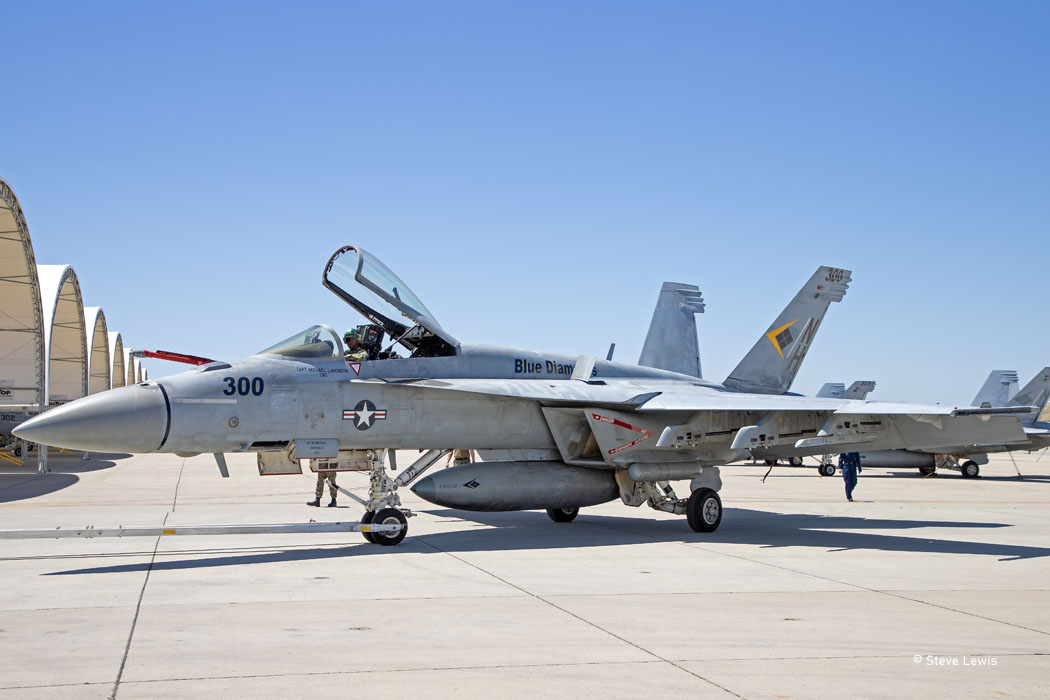
The Blue Diamonds have since flown from the decks of the USS Nimitz, USS Carl Vinson, and USS Theodore Roosevelt, supporting operations in the Middle East and Pacific. Some of these deployments have included Operation Enduring Freedom, Operation Iraqi Freedom, and counter-ISIS operations in Iraq and Syria.

Awards, Milestones, and Recognition
Over the years, VFA-146 has earned:
• Presidential Unit Citation for their final Vietnam War cruise.
• Multiple Navy Unit Commendations and Meritorious Unit Commendations.
• The Battle “E” Efficiency Award, marking them among the Navy’s top squadrons.
• The Michael J. Estocin Award, recognizing the best F/A-18 squadron in the fleet.
• Repeated Safety “S” Awards, a remarkable feat for a unit that has flown decades of high-risk carrier operations.
The Blue Diamonds were also one of the first Navy squadrons to experiment with night strike operations using NVGs (night vision goggles) in the Hornet—a capability now standard across the fleet.

The Diamond Legacy
From Cougars and Crusaders to Hornets and Super Hornets, the Blue Diamonds have adapted to each generation of naval aviation with sharp precision. They are more than just a squadron—they are a case study in adaptability, professionalism, and the Navy’s ability to evolve while retaining its combat edge.
Today, as the Navy looks to integrate the F-35C Lightning II and unmanned aerial systems into carrier air wings, the Blue Diamonds remain a vital bridge between the past and future. They carry with them not just advanced technology, but decades of hard-earned experience forged on steel decks in every ocean.

For the men and women of VFA-146, the Blue Diamond on their patch is more than a symbol. It’s a promise—to the fleet, to the nation, and to each other—that when the call comes, they will always be sharp, ready, and unbreakable.


